New chapters land on a regular cadence. Subscribe to get each one by email.
Most writing about AI stops at the productivity number: AI made this task 40% faster. That’s where the story usually ends. I think it’s where the interesting part begins.
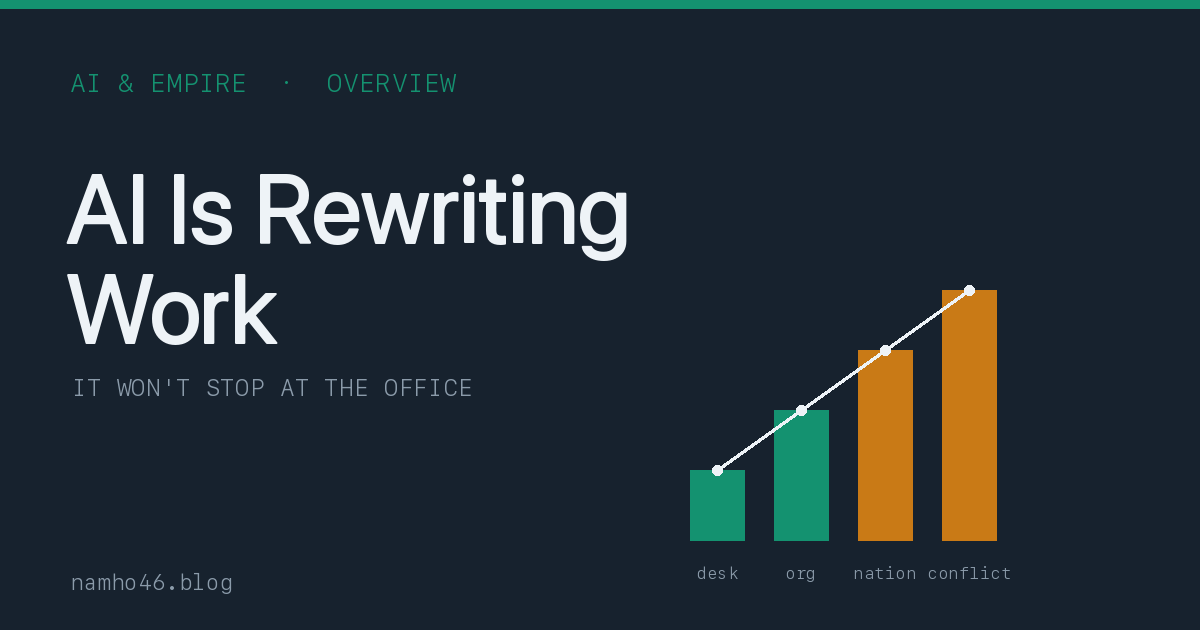
Because a productivity gain never stays put. It moves. It travels up from a single person’s desk to the shape of a company, then to how nations compete, and — if history is any guide — to the grammar of conflict itself. This page is the map of that journey. Each stop below is a short summary; the “→” links open the full chapter, each one grounded in the research.
It starts with a gap between two workers
The first thing AI changes isn’t output. It’s who produces it.
In a 2023 MIT experiment, professionals using AI cut task time by 40% and raised quality by 18%. But the striking finding was hidden in the distribution: the lowest performers improved the most. A Fortune 500 call-center study found the same — a 14% average gain, but 34% for the least-skilled group. Researchers named it skill compression: AI raises the floor faster than the ceiling.
For thirty years, experience was the strongest predictor of performance. Skill compression cracks that formula — and quietly changes what an organization is buying when it hires, keeps, or lets go of people.
Read the full chapter → AI’s ‘Skill Compression’: Why Juniors Catch Up to Veterans
Then it reshapes the organization
Once the floor rises, the next question lands in every management meeting: can we do the same with fewer people?
That’s where the productivity story turns into a talent story. The value that walks out the door when someone leaves — the tacit knowledge, the read on a customer, the instinct filtered from past failure — gets more portable in the AI era, not less, because some of it now lives in prompts and workflows a person can take with them. Cutting talent to bank an efficiency gain can quietly hand that gain to a competitor.
Read the full chapters → What an Organization Loses When Someone Leaves · Keeping Talent Isn’t About Salary
Then it becomes a national question
Scale the same logic up one more level and it stops being about companies.
The resources that decide the AI race — high-quality data, advanced chips, frontier talent — are not like the internet, where everyone using it makes it more valuable. They’re closer to zero-sum: what one side secures, another is denied. At that point a company’s AI capacity reads as a country’s capacity, and “keeping your talent” becomes a question of technological sovereignty.
Read the full chapter → The Internet Grew by Sharing — AI’s Resources Do the Opposite
And it changes the grammar of conflict
Here the productivity story arrives somewhere unexpected — and this is the throughline most coverage misses.
Electricity and the internet spread without automatically arming their owners. AI is different in one decisive way: it is dual-use. A civilian tool converts to a military one in months, not decades. RAND documents the paths — computer-vision AI to strike-drone control, a customer-service language model to disinformation tooling. And it isn’t theoretical: in Ukraine, drones built from commercial parts and open-source software are tied to roughly 70–80% of frontline casualties.
The line between a productivity tool and a weapon is being erased — not in theory, but already in reality.
Read the full chapter → AI Dual-Use: GPS Gave Us Uber, AI Gives Us Drones
The resolution isn’t “get stronger”
If every actor simply hoards talent and capability, you get another round of leveling — and, by the logic above, another basis for conflict. So strength alone isn’t the answer.
Read the full chapter → The Balance That Didn’t Bring Peace
The Cold War offers the template most people forget: the superpowers stacked warheads and built hotlines, non-proliferation treaties, and arms-control talks at the same time. Deterrence and norms worked together. The AI era needs both axes too — internal capability and the norms to keep competition manageable. That’s the argument the series builds toward.
Read the full chapter → The Cold War’s Forgotten Half
Why this blog exists
I’m a developer in Korea who uses AI every day, and that daily use left me with a question I couldn’t shake: where is this all heading? This blog is me trying to answer it carefully — reading the research, following the line from one study out to organizations and nations, and publishing it one short chapter at a time.
If the map above is interesting, follow the links into the chapters, or start with the about page. New chapters land on a regular cadence — and this page will grow as they do.
Epilogue → Closing Season One — What a Single Lens Still Sees


답글 남기기