Two or three foundries make the overwhelming majority of the world’s most advanced AI chips (3nm and below). Frontier AI researchers are estimated at only tens of thousands worldwide. These two numbers explain why the AI race runs on a different grammar than the internet did.
The internet’s grammar: sharing makes it bigger
The internet grows more valuable the more people use it. One country using it more doesn’t make another use it less. We call this the network effect — a structure where sharing benefits everyone.
We’ve largely understood the last half-century of technology through this grammar. So it felt natural to assume technology invites cooperation and that diffusion benefits all.
But the core resources of the AI race don’t follow that grammar.
Three resources that run zero-sum
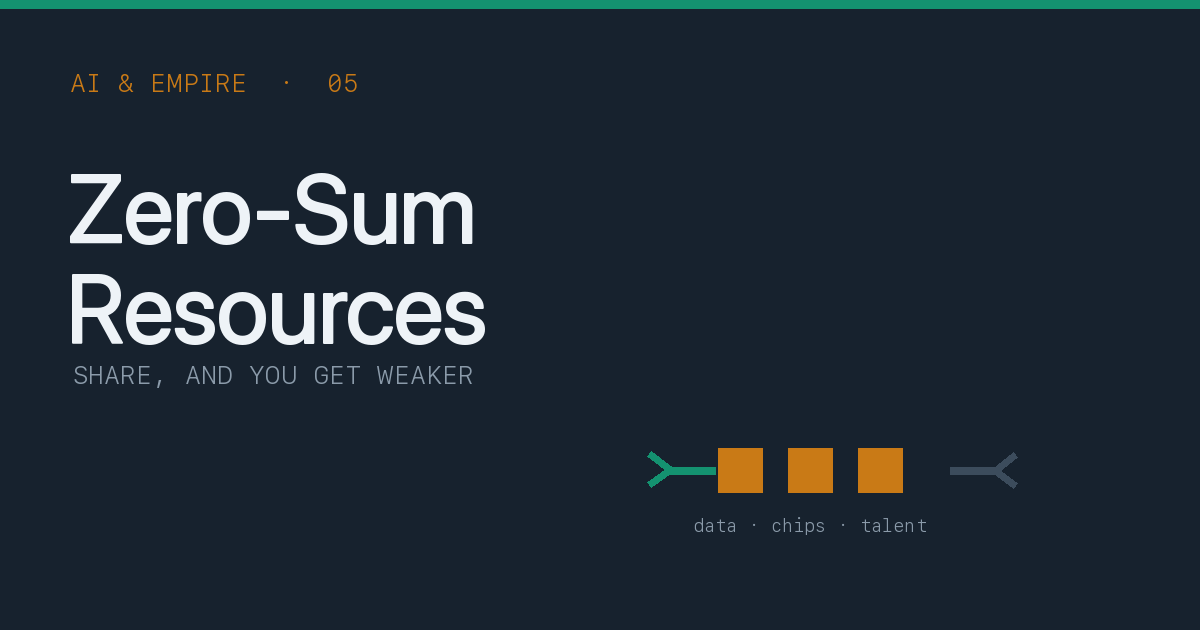
In an early-2026 analysis, the Atlantic Council argues that three resources in the AI race move as a zero-sum structure.
- Data. Exclusive possession of high-quality training data ties directly to model performance. And access-restricted data can’t be reproduced by a rival. What I hold is closed to you.
- Chips. A tiny number of foundries — TSMC, Samsung — monopolize advanced AI-chip production. U.S. export controls on China have turned that scarcity into a strategic weapon.
- Talent. Frontier AI researchers are scarce, on the order of tens of thousands. Big Tech’s hiring wars redistribute the talent pool itself — when one side recruits, another’s pool directly shrinks.
The three share one trait. It isn’t a structure where sharing benefits everyone; it’s one where securing a resource makes your rival weaker.
The internet grew the more it was shared. AI’s core resources make me weaker the more I share.
Why this reshapes geopolitics
When resources are zero-sum, the character of the competition around them changes too.
In a world of network effects, a rival’s growth helps you — the pie grows together. But in a zero-sum world, a rival’s gain reads as your loss. Here the incentive to cooperate weakens, and the incentive to secure and control grows stronger.
Layer on AI’s dual-use nature from an earlier piece — a civilian tool that becomes a weapon in months — and the two properties combine: a technology that can become a weapon at any time, standing on resources that make you weaker the more you share. That combination places AI somewhere other than electricity or the internet.
So “who holds the data,” “who makes the chips,” “who takes the talent” is no longer a corporate question. It becomes a national one — a question of technological sovereignty.
Part of the series: AI Is Rewriting Work — and It Won’t Stop at the Office
Sources. Atlantic Council (2026, Jan 15), Eight Ways AI Will Shape Geopolitics in 2026 — analysis of the zero-sum structure of the AI race’s three resources (data, chips, talent): exclusive data possession tied to model quality and non-reproducible by rivals; monopoly of sub-3nm advanced-chip production by a few foundries (TSMC, Samsung) plus U.S. export controls on China; frontier AI talent on the order of tens of thousands with zero-sum recruiting dynamics.
답글 남기기