The last chapter left a hard question. If getting stronger only resets the race — and pushes the conflict into new channels — is there any way out at all? History ran this experiment once. Its answer wasn’t “get stronger.” It was “get stronger and build the rules — at the same time.”
The Cold War’s forgotten half
Everyone remembers the warheads. Few remember what the same two superpowers built alongside them.
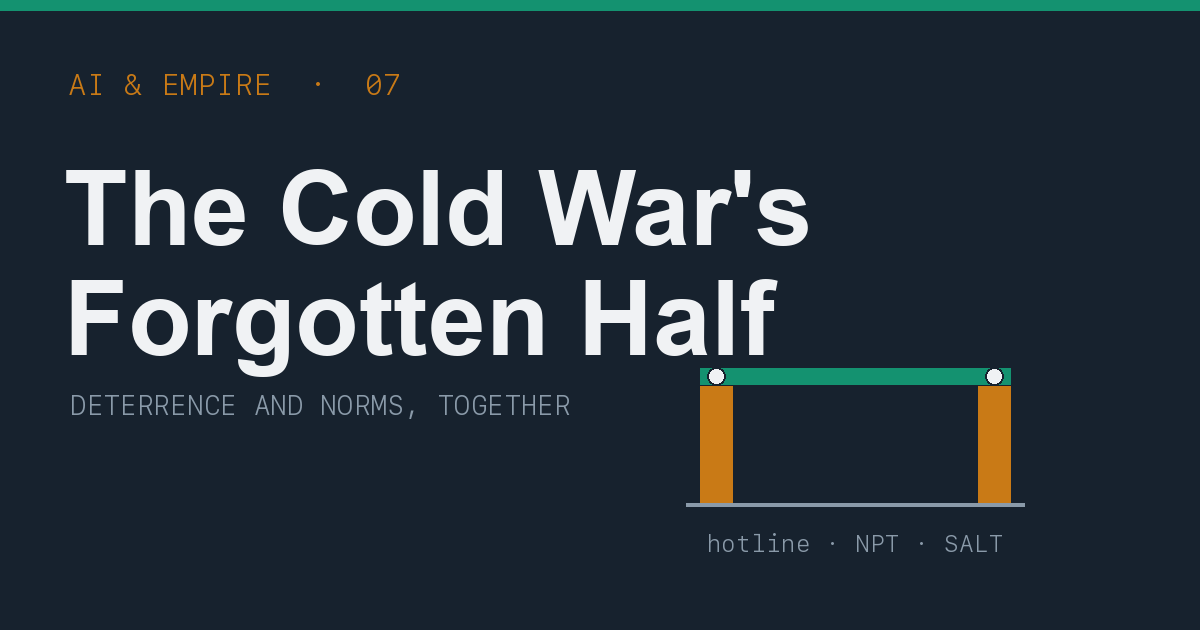
At the height of the nuclear standoff, the United States and the Soviet Union stacked weapons — and simultaneously opened the Moscow–Washington hotline (1963), signed the Nuclear Non-Proliferation Treaty (adopted 1968), and negotiated the first Strategic Arms Limitation Treaty, SALT I (1972). Deterrence and norms were built in the same years, by the same rivals.
The result wasn’t peace. It was something narrower and more valuable: the prevention of total nuclear war.
Strength and cooperation aren’t opposites
The usual framing treats “get strong” and “cooperate” as a choice — pick one. The Cold War shows they’re complements.
Deterrence without norms is a hair-trigger: capability with no channel to manage a crisis. Norms without deterrence is a wish: rules no one has reason to keep. Put together, they produce something neither can alone — strategic stability.
Strength and cooperation aren’t opposites. In the one experiment history has run, they only worked together.
The AI era needs the same two axes
Run it forward to AI, and the template holds.
The first axis is internal capability. Because AI is dual-use, a capability gap is a defensive vulnerability, not just a competitive one. Protecting talent, opening tool access across an organization, redesigning how work is done — these are the defense of technological sovereignty. (Which is why shedding talent carelessly, as an earlier chapter argued, is punching a hole in your own line.)
The second axis is conflict-management norms. International agreement on autonomous-weapons limits, data governance, and AI-safety standards is what keeps competition from tipping into catastrophe.
The window is closing
There’s a deadline built into this. Specialists call the present moment the “pre-proliferation window” — the last stretch before autonomous weapons diffuse beyond control, the way small arms did. Once they spread, norms are far harder to write. Analysts point to the Convention on Certain Conventional Weapons’ Seventh Review Conference, set for November 2026, as a practical deadline.
Which means the two axes can’t be built in sequence — strength now, rules later. They have to be built together, and soon.
Where the series lands
This is where a long line finally arrives. A single “40% faster” at one desk traveled up to the shape of a company, to how nations compete, to the grammar of conflict. And at the end, the resolution isn’t to win the race.
It’s to change what winning means: strength paired with the rules that keep strength from becoming catastrophe. The Cold War is the one time humanity held those two together long enough to survive its own capabilities. The AI era is asking whether we can do it again — faster.
Part of the series: AI Is Rewriting Work — and It Won’t Stop at the Office
Sources. Arms Control Association historical briefs; Thomas C. Schelling (1966), Arms and Influence, Yale University Press — the crisis-management mechanisms the US and USSR built after the Cuban Missile Crisis (1962): the Moscow–Washington hotline (1963), the Nuclear Non-Proliferation Treaty (adopted 1968, in force 1970), and SALT I (1972); Schelling’s account of deterrence and norms as complementary supports of strategic stability. On mutual assured destruction: Thomas C. Schelling (1960), The Strategy of Conflict. On the “pre-proliferation window”: Usanas Foundation (2026), Regulating Lethal Autonomous Weapons Systems in a Fractured Multipolar Order, which points to the CCW’s Seventh Review Conference (16–20 November 2026, Geneva) as a practical deadline.
답글 남기기