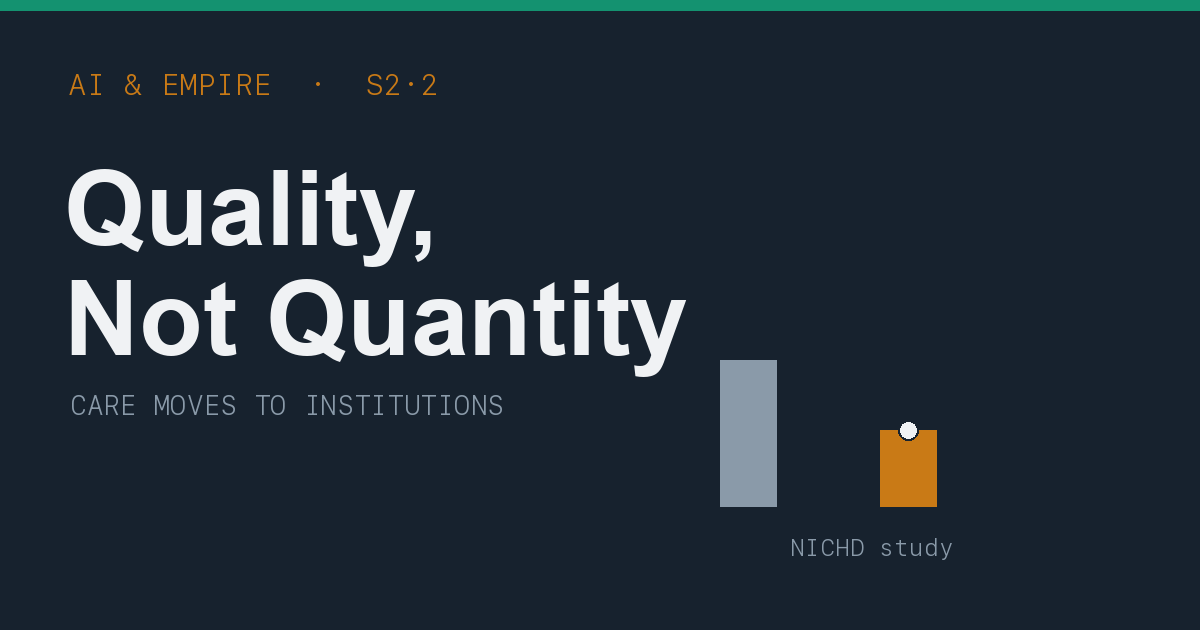
In the late twentieth century, as dual-income households grew and childcare centers spread, raising moved — from the home into institutions. An old worry followed close behind: does leaving a child in care for long hours cost something? One study answered that question with data instead of instinct.
Raising moved into institutions
The NICHD followed this shift with a large longitudinal study. It tracked children across many sites, from birth into the school years, measuring how childcare shaped their development.
Why that design matters is simple. The effects of care don’t show up in a year or two, and small samples can’t be told apart from chance.
And its conclusion cut against the common worry. The question wasn’t “how long.”
Quality, not quantity
The central finding fits in one line — what mattered was not the amount of time but the quality of care.
Children in high-quality care showed better cognitive, language, and school-readiness outcomes. Long hours, meanwhile, showed a weak association with early behavior problems — a weak association, not a strong cause.
And over all of it sat one moderator: maternal sensitivity. The relationship at home filtered or amplified what the institution did. The institution didn’t replace the home; the two worked together.
Quality pays — if you can get it
So what happens if you push quality all the way up? The economist James Heckman tracked that answer across decades.
Perry Preschool and Abecedarian — intensive, high-quality programs designed to run from birth to age five. In Heckman’s analysis, they returned 7 to 13 percent per year on the money invested, decades later — paid back in better education and employment, better health, and less crime.
But that number carries a footnote. The 7 to 13 percent belongs to research-grade, intensive programs. Most real-world childcare never reaches that level of quality. “Quality decides” therefore cuts both ways — quality pays, enormously. But that kind of quality is rare.
The effects are modest — and that’s the point
Here the season sets its rule. The effects the NICHD found in the ordinary range of care were real but mostly modest, while Heckman’s large returns belonged to rare, intensive programs. The two numbers don’t contradict each other; they are two sides of the same picture.
That modesty isn’t a disappointing result; it’s an honest one. Neither calling high-quality care a cure-all nor long hours a catastrophe — saying only as much as the data allows.
What mattered was quality, not quantity, and even those effects were modest. Neither fear nor praise runs ahead of the data.
Here the principle this season will keep is set. Raising is the handing-down, generation to generation, of a tacit knowledge no document holds — its effects are hard to see, and the measurement is always incomplete. So we trim our sentences to the size of the evidence. “Quality decides,” “the effects are modest,” “that kind of quality is rare” — neither fear nor praise runs ahead of the data.
Sources. NICHD Early Child Care Research Network, Study of Early Child Care and Youth Development. Key findings: the quality of care had a modest positive effect on cognitive, language, and school-readiness outcomes; long hours in care showed a weak association with early behavior problems; effect sizes were generally modest; and maternal sensitivity moderated the outcomes. (Summaries: Reading Rockets; follow-up papers via PMC.) James J. Heckman’s research on early-childhood investment (The Heckman Equation) — high-quality, intensive birth-to-five programs such as Perry Preschool and Abecedarian returned 7–13% per year (gains in education, employment, and health; reductions in crime).
답글 남기기