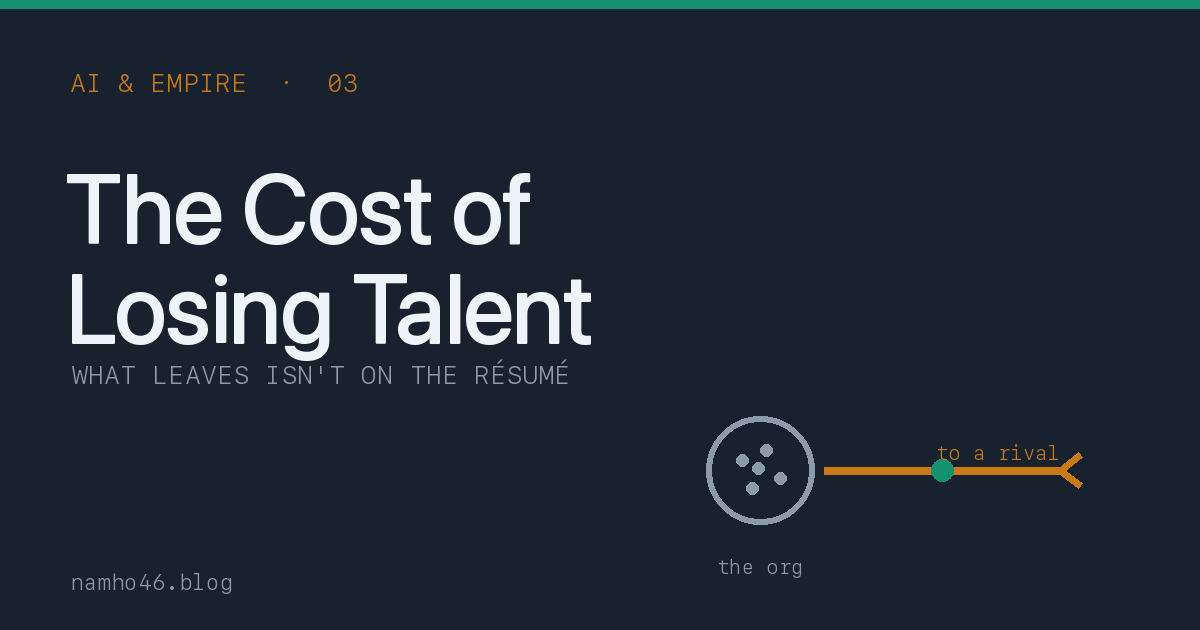
When someone leaves an organization, what exactly does the organization lose? A contract lists their salary and their role — but the things that actually leave with them aren’t written there.
What leaves isn’t on the résumé
The things that never made it onto a résumé leave too. A feel for how the place actually works. An ear for what a customer needs but hasn’t said. Instinct filtered from past failure.
Organizational theory calls this tacit knowledge — the kind you have but can’t quite put into words. It doesn’t live in documents; it settles inside a person as the sediment of experience. Explicit knowledge — manuals, wikis, code comments — stays with the organization when someone goes. Tacit knowledge walks out with them.
None of this is new; it’s Nonaka’s organizational theory from 1994. What’s new is that AI has added a variable to the equation.
The equation AI changed
AI tools accumulate how a person works in a structured form. Years of domain knowledge get left behind as prompts and chat logs. If someone has told an AI, again and again, “handle this task in this order, watching for these exceptions,” part of that judgment — the part never written in any doc — is already made explicit.
And knowledge made explicit can travel with the person.
An engineer leaving for a competitor is one thing. Leaving with their own knowledge, distilled by AI, is another.
Let’s not overstate it. Adapting to a new organization’s culture and processes still takes time; knowledge isn’t copied wholesale overnight. But the direction is clear — as AI advances, the strategic cost of losing talent doesn’t fall. It rises.
So what do you prepare?
Treating talent as a cost and shedding it carelessly isn’t a simple HR mistake in the AI era. It’s letting your organization’s memory drain away — now in a form that can move to a competitor. Keeping people, in turn, isn’t only about salary; it’s a question of structure — which the next piece takes up.
The starting point is surprisingly plain. Before you try to hold on to the person who’s leaving, first build the structure that lets the tacit knowledge of the people already here stay inside the organization. That’s why, in the AI era, talent is less a “cost” than a vessel holding a kind of sovereignty.
Part of the series: AI Is Rewriting Work — and It Won’t Stop at the Office
Sources. Nonaka, I. (1994), A Dynamic Theory of Organizational Knowledge Creation, Organization Science 5(1) — the explicit/tacit distinction; knowledge you “know more than you can tell.” · Brass & Burkhardt (1993), Potential Power and Power Use, AMJ 36(3) — knowledge embedded in social networks, lost when members leave. AI may partly lower that barrier.
답글 남기기