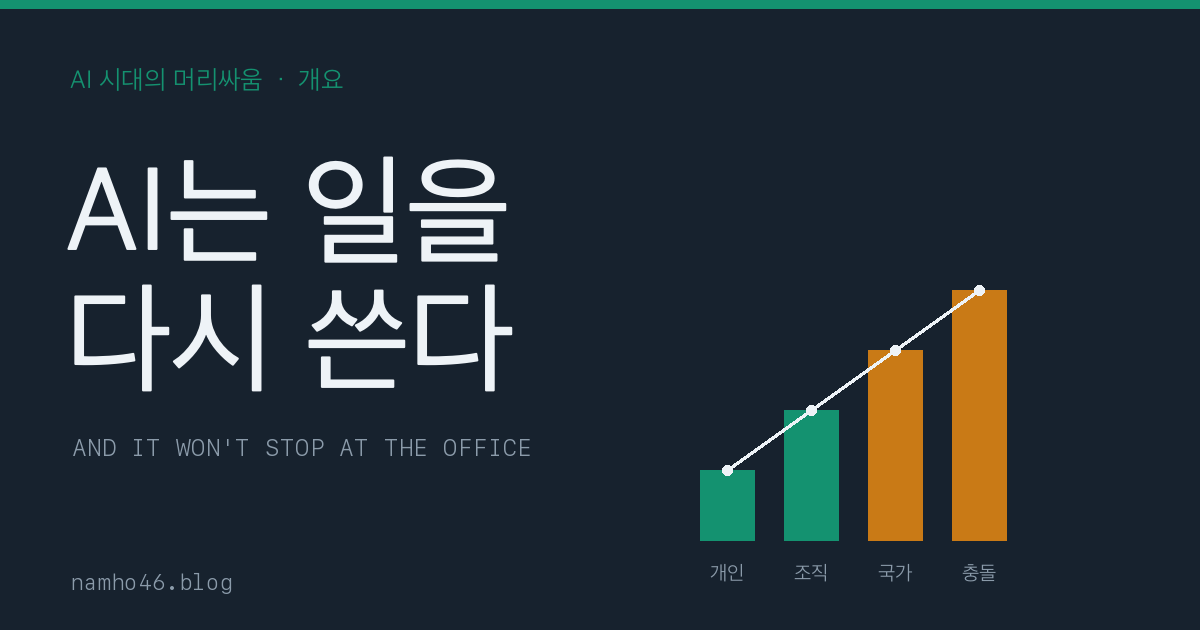
AI에 관한 대부분의 글은 생산성 수치에서 멈춘다. AI가 이 작업을 40% 빠르게 만들었다. 보통 이야기는 거기서 끝난다. 나는 흥미로운 부분이 바로 거기서 시작한다고 생각한다.
생산성의 향상은 결코 한자리에 머물지 않기 때문이다. 그것은 움직인다. 한 사람의 책상에서 회사의 모양으로, 다시 국가가 경쟁하는 방식으로, 그리고 — 역사가 말해준다면 — 충돌의 문법으로까지 번져 올라간다. 이 페이지는 그 여정의 지도다. 아래 각 정거장은 짧은 요약이고, “→” 링크가 연구에 근거한 각 챕터의 전문을 연다.
두 노동자 사이의 격차에서 시작한다
AI가 처음 바꾸는 것은 산출물이 아니다. 누가 그것을 만드는가다.
2023년 MIT 실험에서 AI를 쓴 전문직은 작업 시간을 40% 줄이고 품질을 18% 높였다. 그러나 놀라운 발견은 분포 속에 숨어 있었다 — 하위 성과자들의 향상폭이 가장 컸다. Fortune 500 콜센터 연구도 같은 결과를 냈다. 전체 평균 14% 향상, 그러나 하위 숙련군은 34%. 연구진은 이를 스킬 압축이라 불렀다. AI는 천장보다 바닥을 더 빠르게 끌어올린다.
30년간 경험은 성과의 가장 강력한 예측 변수였다. 스킬 압축은 그 공식에 균열을 낸다 — 그리고 조직이 사람을 채용하고, 붙잡고, 내보낼 때 무엇을 사고파는지를 조용히 바꾼다.
바닥이 올라가면, 다음 질문이 모든 경영 회의에 등장한다. 더 적은 인원으로 같은 성과를 낼 수 있는 것 아닌가?
여기서 생산성 이야기는 인재 이야기로 바뀐다. 한 사람이 떠날 때 함께 나가는 가치 — 암묵지, 고객을 읽는 감각, 실패에서 걸러낸 직관 — 는 AI 시대에 오히려 더 이동 가능해진다. 그 일부가 이제 프롬프트와 워크플로에 남아 사람과 함께 움직이기 때문이다. 효율을 얻으려 인재를 내보내는 것은 그 효율을 조용히 경쟁사에 넘기는 일이 될 수 있다.
AI 경쟁을 결정하는 자원 — 고품질 데이터, 첨단 반도체, 프런티어 인재 — 은 인터넷과 다르다. 인터넷은 모두가 쓸수록 가치가 커지지만, 이 자원들은 제로섬에 가깝다. 한쪽이 확보하면 다른 쪽은 그만큼 잃는다. 그 지점에서 한 기업의 AI 역량은 한 국가의 역량으로 읽히고, “인재를 지키는 일”은 기술 주권의 문제가 된다.
여기서 생산성 이야기는 예상 밖의 곳에 도착한다 — 그리고 이것이 대부분의 보도가 놓치는 줄기다.
전기와 인터넷은 소유자를 자동으로 무장시키지 않으며 퍼졌다. AI는 한 가지 결정적인 점에서 다르다. 이중 사용(dual-use)이다. 민간 도구가 수십 년이 아니라 수개월 만에 군사용으로 전환된다. RAND는 그 경로를 기록한다 — 컴퓨터 비전 AI가 타격 드론 제어로, 고객 서비스 언어 모델이 허위정보 도구로. 그리고 이것은 이론이 아니다. 우크라이나에서, 상업용 부품과 오픈소스로 만든 드론이 전선 사상자의 약 70~80%와 얽혀 있다.
냉전은 대부분이 잊은 본보기를 남겼다. 초강대국들은 핵탄두를 쌓으면서 동시에 핫라인, 핵비확산조약, 군축 협상을 만들었다. 억지와 규범이 함께 작동했다. AI 시대에도 두 축이 필요하다 — 내부 역량 그리고 경쟁을 관리 가능하게 유지하는 규범. 이 시리즈가 향해 가는 논지다.
나는 한국에 사는 개발자이고 매일 AI를 쓴다. 그렇게 매일 쓰다 보니 떨쳐지지 않는 질문이 생겼다 — 이건 대체 어디로 가고 있을까? 이 블로그는 그 질문에 조심스럽게 답해보려는 시도다 — 연구를 읽고, 하나의 논문에서 시작한 선을 조직과 국가까지 따라가며, 짧은 챕터로 하나씩 적어 나간다.
위 지도가 흥미롭다면 링크를 따라 각 챕터로 들어가거나, 소개 페이지부터 시작해도 좋다. 새 챕터는 일정한 간격으로 올라오고, 이 페이지도 그와 함께 자라난다.
New chapters land on a regular cadence. Subscribe to get each one by email.
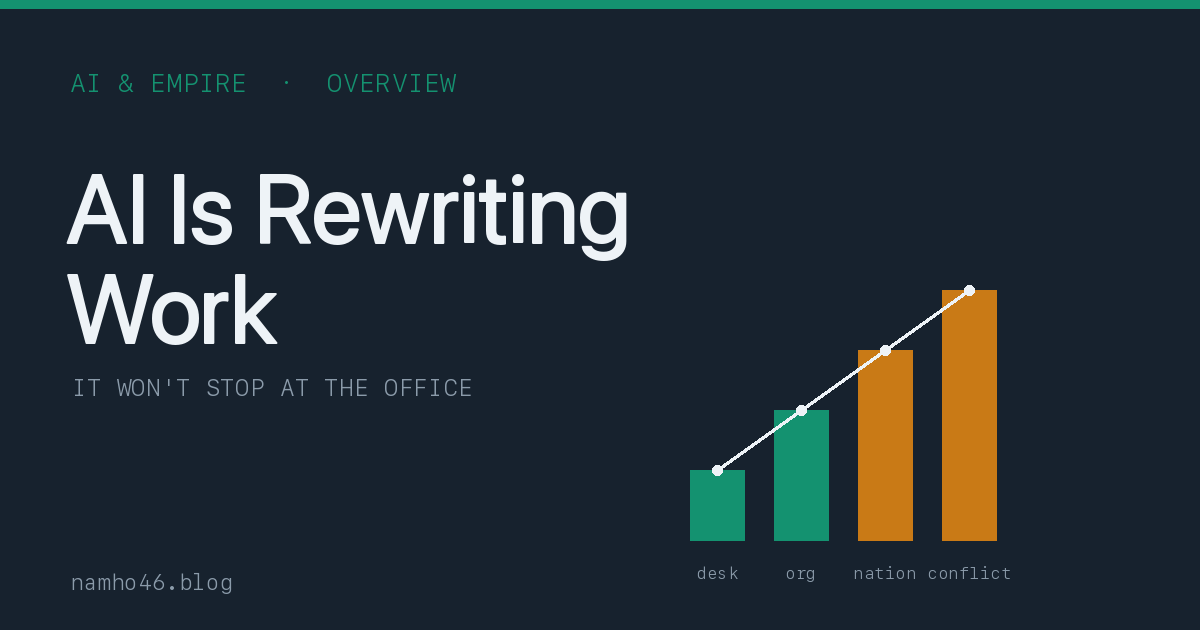
Most writing about AI stops at the productivity number: AI made this task 40% faster. That’s where the story usually ends. I think it’s where the interesting part begins.
Because a productivity gain never stays put. It moves. It travels up from a single person’s desk to the shape of a company, then to how nations compete, and — if history is any guide — to the grammar of conflict itself. This page is the map of that journey. Each stop below is a short summary; the “→” links open the full chapter, each one grounded in the research.
It starts with a gap between two workers
The first thing AI changes isn’t output. It’s who produces it.
In a 2023 MIT experiment, professionals using AI cut task time by 40% and raised quality by 18%. But the striking finding was hidden in the distribution: the lowest performers improved the most. A Fortune 500 call-center study found the same — a 14% average gain, but 34% for the least-skilled group. Researchers named it skill compression: AI raises the floor faster than the ceiling.
For thirty years, experience was the strongest predictor of performance. Skill compression cracks that formula — and quietly changes what an organization is buying when it hires, keeps, or lets go of people.
Once the floor rises, the next question lands in every management meeting: can we do the same with fewer people?
That’s where the productivity story turns into a talent story. The value that walks out the door when someone leaves — the tacit knowledge, the read on a customer, the instinct filtered from past failure — gets more portable in the AI era, not less, because some of it now lives in prompts and workflows a person can take with them. Cutting talent to bank an efficiency gain can quietly hand that gain to a competitor.
Scale the same logic up one more level and it stops being about companies.
The resources that decide the AI race — high-quality data, advanced chips, frontier talent — are not like the internet, where everyone using it makes it more valuable. They’re closer to zero-sum: what one side secures, another is denied. At that point a company’s AI capacity reads as a country’s capacity, and “keeping your talent” becomes a question of technological sovereignty.
Here the productivity story arrives somewhere unexpected — and this is the throughline most coverage misses.
Electricity and the internet spread without automatically arming their owners. AI is different in one decisive way: it is dual-use. A civilian tool converts to a military one in months, not decades. RAND documents the paths — computer-vision AI to strike-drone control, a customer-service language model to disinformation tooling. And it isn’t theoretical: in Ukraine, drones built from commercial parts and open-source software are tied to roughly 70–80% of frontline casualties.
The line between a productivity tool and a weapon is being erased — not in theory, but already in reality.
If every actor simply hoards talent and capability, you get another round of leveling — and, by the logic above, another basis for conflict. So strength alone isn’t the answer.
The Cold War offers the template most people forget: the superpowers stacked warheads and built hotlines, non-proliferation treaties, and arms-control talks at the same time. Deterrence and norms worked together. The AI era needs both axes too — internal capability and the norms to keep competition manageable. That’s the argument the series builds toward.
I’m a developer in Korea who uses AI every day, and that daily use left me with a question I couldn’t shake: where is this all heading? This blog is me trying to answer it carefully — reading the research, following the line from one study out to organizations and nations, and publishing it one short chapter at a time.
If the map above is interesting, follow the links into the chapters, or start with the about page. New chapters land on a regular cadence — and this page will grow as they do.
Books, daycare, television, smartphones. It’s the list of technologies that raised children over the last hundred years. But thread these four eras onto a single sentence — and what does that sentence warn us about what’s coming?
One sentence through four eras
The pattern is clear.
Each time, technology moved the authority and the background of raising — from the tacit knowledge at your side to standardized outside knowledge. Books replaced the grandmother’s hand with a table of contents; daycare moved raising from the home to the institution; TV changed the very air of the house.
The effects were mostly modest, quality decided the outcome, and the debate always arrived late. The smartphone is the latest case — whether it really broke a generation’s mental health is still contested (unsettled), and we had already placed the technology beside our children long before any verdict came in.
And every time, who set the standard narrowed or widened the next generation’s field of view.
AI-nurture doubles the pattern
AI enters raising from two directions at once. One is the AI that raises children — a majority of US teens already use conversational companions. The other is the AI that humans raise — the “values” of a model billions will use were, early on, shaped by a labeling team numbering in the dozens.
What the two directions share is the whole point: both spread a default set by a few to the many. The pattern by which a village’s tacit knowledge migrated into one expert’s book repeats here, at an extreme.
This is where Season 1 returns. Its first chapter showed AI lifts the floor of ability faster than the ceiling. The more skill is leveled, the more the one thing that stays a person’s own is the seat they look at the world from — a biased lens. The epilogue argued that tilt is not a defect but a point of view, the last asset that resists leveling.
But if narrow nurture homogenizes that lens — then the last diversity we were trying to protect is leveled too.
If the last asset in an age of skill compression is a “biased lens,” then nurture that homogenizes the lens erases the very asset it was meant to protect.
The machines say the same thing
This claim — that sameness narrows the lens — has one more, unexpected witness: the machine itself.
A 2024 study in Nature reported “model collapse.” Train a generative AI recursively on its own output, and across generations the distributional errors accumulate — and the low-frequency events, the tails of the distribution, disappear first, and permanently. The rare goes first; the output converges toward the average and then degrades. There is only one way to prevent it: periodically inject fresh human data.
This is not an analogy but a direct observation in machine learning. And the mechanism reproduces the season’s thesis literally — in a system fed only more of the same, the rare vanishes first, and what remains grows fragile together.
Biology already knows the answer
Biology says the same sentence.
One experiment demonstrated that a microbial population, facing an unpredictable environment, deliberately spreads its phenotypes — some individuals lose out, but the population as a whole survives whatever change comes. It’s called bet-hedging. A uniform population collapses together when the environment shifts. Diversity is the hedge.
You can’t map a microbe’s survival strategy straight onto human perspective (this is an analogy). But the structure is the same — and now that structure is pointed to, at once, by biology’s bet-hedging and machine learning’s model collapse, each in its own language. An ecosystem of viewpoints that has converged on a single default becomes fragile, together, in front of a change no one saw coming. Uniformity degrades; diversity is the hedge.
So the answer isn’t “don’t nurture” — that’s impossible. The answer is the same one Season 1 reached. Make what is injected visible, and keep the set of nurturers diverse.
If Season 1 asked how AI rewrites work and power, Season 2’s question was this — who raises the lens that will live in that world, and out of what. The reason one person’s biased lens is precious is that it is the last place that resists sameness. How to hold that place — this is where the season lands.
Sources. Shumailov, I. et al. (2024), AI models collapse when trained on recursively generated data, Nature — demonstrating that training generative models recursively on their own output permanently erases the tails of the distribution (low-frequency events), collapsing output diversity, and that periodic injection of fresh human data is required to prevent it (model collapse is a direct ML observation, not an analogy). Beaumont, H. J. E. et al. (2009), Experimental evolution of bet hedging, Nature — demonstrating the fragility of uniform populations in unpredictable environments and the hedging function of phenotypic diversity (bet-hedging); the application to human perspective diversity is flagged as an analogy. On RLHF labelers being few (early InstructGPT ~40) and skewed in geography and demographics: Ouyang, L. et al. (2022), Training language models to follow instructions with human feedback; Kirk, H. R. et al. (2024), “RLHF: whose culture, whose values?”. On AI-companion use (72% of US teens have used one, 52% regularly): Common Sense Media (2025), Talk, Trust, and Trade-Offs (NORC, n = 1,060). On the smartphone–teen mental health causal question remaining unsettled: Haidt (2024), The Anxious Generation vs Odgers (2024), Nature review; Science (2024).
책, 보육 시설, 텔레비전, 스마트폰. 백 년 사이 아이를 기른 기술의 목록이다. 그런데 이 네 시대를 한 문장으로 꿰면 — 그 문장은 앞으로 올 것에 대해 우리에게 무엇을 경고하는가?
네 시대를 관통하는 한 문장
패턴은 분명하다.
기술은 매번 양육의 권위와 배경을 옮겼다 — 곁의 암묵지에서 표준화된 외부 지식으로. 책은 할머니의 손을 목차로 바꿨고, 보육은 가정을 제도로, TV는 집의 공기 자체를 바꿨다.
그 효과는 대체로 완만했고, 질이 좌우했으며, 논쟁은 늘 뒤늦게 따라왔다. 스마트폰이 그 최신 사례다 — 그것이 한 세대의 정신건강을 정말 무너뜨렸는지는 아직 논쟁 중이고(미결), 우리는 결론이 나기 한참 전에 이미 그 기술을 아이 곁에 들여놓았다.
그리고 매번, 누가 그 표준을 정하는가에 따라 다음 세대의 시야가 좁아지거나 넓어졌다.
AI 양육은 이 패턴을 두 배로 실현한다
AI는 양육에 두 방향으로 동시에 들어온다. 하나는 아이를 기르는 AI다 — 이미 미국 청소년의 다수가 대화형 컴패니언을 쓴다. 다른 하나는 인간이 기르는 AI다 — 수십억 명이 쓸 모델의 ‘가치관’이, 초기에는 수십 명 규모의 라벨러 손에서 다듬어졌다.
두 방향의 공통점이 핵심이다. 둘 다 소수가 정한 기본값을 다수에게 확산시킨다. 마을의 암묵지가 한 전문가의 책으로 옮겨갔던 그 패턴이, 여기서 극단으로 반복된다.
여기서 시즌 1이 되돌아온다. 첫 챕터는 AI가 능력의 바닥을 천장보다 빠르게 끌어올린다고 했다. 스킬이 평준화될수록, 끝까지 사람에게 남는 차별성은 세상을 바라보는 자리 — 편향된 시선이었다. 에필로그는 그 기울기가 결함이 아니라 관점이며, 평준화에 저항하는 마지막 자산이라고 했다.
그런데 그 시선을 좁은 양육이 획일화한다면 — 우리가 끝까지 지키려던 마지막 다양성마저 평준화된다.
스킬이 평준화되는 시대에 마지막까지 남는 자산이 ‘편향된 시선’이라면, 그 시선을 획일화하는 양육은 지키려던 자산 자체를 지운다.
기계도 같은 말을 한다
획일화가 관점을 좁힌다는 이 주장에는, 뜻밖의 증인이 하나 더 있다 — 기계 자신이다.
2024년 네이처에 실린 한 연구는 ‘모델 붕괴(model collapse)’를 보고했다. 생성형 AI를 자신이 만든 데이터로 재귀적으로 다시 학습시키면, 세대를 거칠수록 분포의 오차가 쌓이고 — 저빈도 사건, 즉 분포의 꼬리가 먼저, 그리고 영구히 사라진다. 출력은 평균으로 수렴하다 무너진다. 이를 막는 길은 하나뿐이다 — 신선한 인간 데이터를 주기적으로 다시 넣는 것.
이건 유추가 아니라 기계학습의 직접 관측이다. 그리고 그 메커니즘이 이 시즌의 논지를 문자 그대로 재현한다 — 같은 것만 먹인 계에서는 드문 것부터 사라지고, 남은 것은 함께 취약해진다.
생물학이 이미 아는 답
생물학도 같은 문장을 말한다.
한 실험은 미생물 집단이 예측 불가능한 환경에서 표현형을 일부러 다양하게 분산시키는 전략 — 일부 개체는 손해를 보더라도 집단 전체는 어떤 변화에도 살아남는 ‘베트헤징(bet-hedging)’ — 을 실증했다. 균일한 집단은 환경이 바뀌면 함께 무너진다. 다양성이 곧 그 헤지다.
미생물의 적응 전략을 인간의 관점에 곧바로 대입할 수는 없다(유추다). 다만 구조는 같다 — 그리고 이제 그 구조를 생물학의 베트헤징과 기계학습의 모델 붕괴가 각자의 언어로 동시에 가리킨다. 하나의 기본값으로 수렴한 관점의 생태계는, 아무도 예측하지 못한 변화 앞에서 함께 취약해진다.
그렇다면 답은 ‘기르지 말자’가 아니다 — 그건 불가능하다. 답은 시즌 1의 결론과 같다. 무엇을 주입하는지 보이게 하고, 그 양육자를 다양하게 열어두는 것.
시즌 1이 ‘AI가 일과 권력을 어떻게 바꾸는가’였다면, 시즌 2의 질문은 이것이었다 — 그 세계를 살아갈 시선은 누가, 무엇으로 기르는가. 한 사람의 편향된 시선이 소중한 이유는, 그것이 획일화에 저항하는 마지막 자리이기 때문이다. 그 자리를 지키는 법 — 여기가 이 시즌이 도착한 자리다.
근거. Shumailov, I. et al. (2024), AI models collapse when trained on recursively generated data, Nature — 생성 모델을 자기 생성 데이터로 재귀 학습하면 분포의 꼬리(저빈도 사건)가 영구 소멸하고 출력 다양성이 붕괴하며, 이를 막으려면 신선한 인간 데이터의 주기적 주입이 필요함을 실증(모델 붕괴는 유추가 아닌 직접적 ML 관측). Beaumont, H. J. E. et al. (2009), Experimental evolution of bet hedging, Nature — 예측 불가능한 환경에서 균일 집단의 취약성과 표현형 다양성(bet-hedging)의 헤지 기능을 실증. 인간 관점 다양성에 대한 적용은 유추임을 밝힌다. RLHF 라벨러가 소수(초기 InstructGPT ~40명)이고 지리·인구 구성이 편중돼 있다는 서술: Ouyang, L. et al. (2022), Training language models to follow instructions with human feedback; Kirk, H. R. et al. (2024), “RLHF: whose culture, whose values?”. AI 컴패니언 사용률(미 청소년 72% 사용 경험·52% 정기 사용): Common Sense Media (2025), Talk, Trust, and Trade-Offs (NORC, 표본 1,060명). 스마트폰–청소년 정신건강의 인과가 아직 미결(unsettled)이라는 서술: Haidt (2024), The Anxious Generation vs Odgers (2024), Nature 비평; Science (2024).
In an office somewhere, a handful of people sit at their screens. Two answers to the same question appear side by side. They keep one and discard the other. This one is better; that one isn’t. Click, next. Click, next. It is tedious work. And yet, at the fingertips of a few dozen people in that room, the character of a machine that billions will soon talk to is being decided.
This is not a metaphor — it is structural nurture
An LLM is born after swallowing an enormous amount of data. But the model fresh out of pretraining doesn’t yet know what counts as polite, or what it must not say. In the next stage, a small number of humans teach it — over and over — that this answer is good and that one is bad. This is reinforcement learning from human feedback, RLHF.
What counts as courtesy, what gets filtered as dangerous, which perspective becomes the default — all of it is injected at this stage. If pretraining gives the child language, this stage gives the child a temperament. It isn’t a metaphor. Like the handing-down of tacit knowledge between generations, it is, structurally, nurture.
And the “parents” are astonishingly few
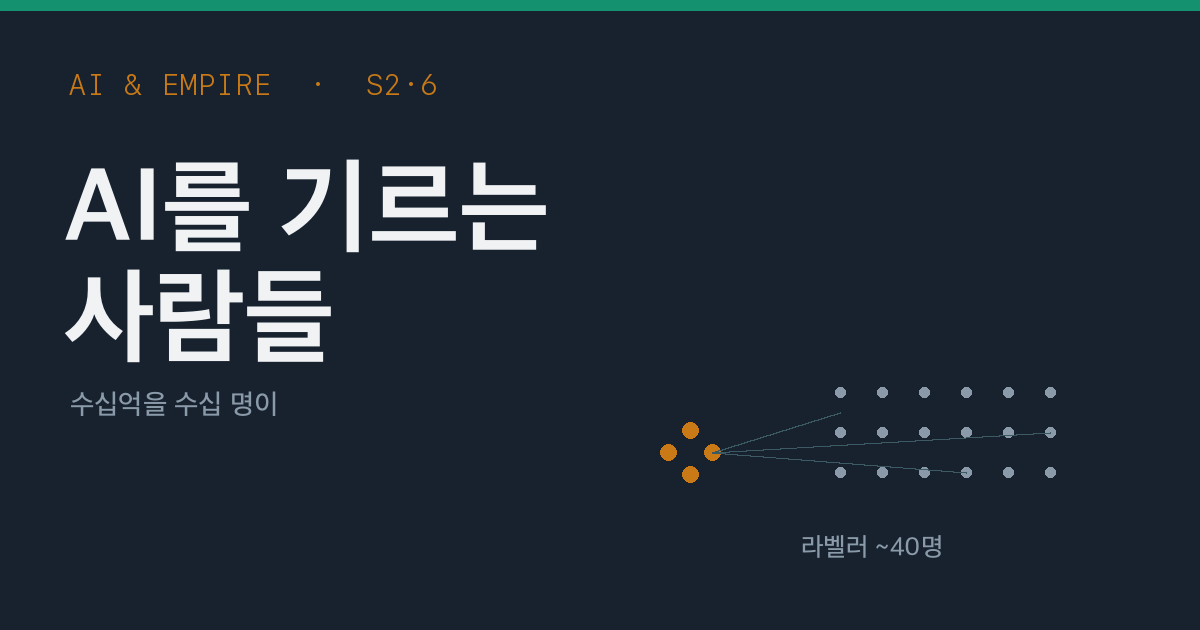
The trouble is the number and the narrowness of those who raise it. The labelers who shaped early InstructGPT numbered around forty, and their geographic and demographic makeup was skewed toward particular regions and groups.
A few dozen people. What they found polite and what they found offensive becomes the default that billions will meet every day. Later work argues this skew is no accident — a labeler’s culture and values are written straight into the model’s. Whose manners? Whose common sense? The question is answered, quietly, inside that narrow room.
The values billions will use are raised by the hands of dozens.
Where those hands are
And those hands are not only in Silicon Valley. In January 2023, a TIME investigation showed where one of those rooms actually sits. Through the outsourcing firm Sama, OpenAI had workers in Kenya sort toxic text — graphic descriptions of abuse and self-harm — to build ChatGPT’s safety filter: the machine’s sense of what must not be said.
The take-home wage was roughly $1.32 to $2 an hour. OpenAI paid Sama about $12.50 an hour per worker. A machine’s manners are not free — they are a default built by people who spend their days reading the darkest sentences the internet has produced. There are efforts to widen the hands, yes. But the hands that set today’s defaults remain few, and the cost of the raising is not evenly paid.
The pattern of Chapter 1, repeated at the extreme
We saw this shape already, in this season’s first chapter. The moment when the parenting a village and its kin had handed down for generations moved into a single book by a single expert — authority shifting from the many close at hand to a standardized few.
RLHF is that shift taken to its extreme. This time it isn’t one book but one handful of hands, setting the default not for a village but for the whole planet. The benefit is clear — a consistent, filtered, predictable partner. The cost has the same shape as before. The standard goes universal before anyone can see who set it.
If talent isn’t born but raised, AI is no different — only it is raised far more narrowly. The machine that raises us is itself raised by a few dozen hands. Widening those hands is the last diversity this season means to defend.
Sources. Ouyang, L. et al. (2022), Training language models to follow instructions with human feedback (InstructGPT) — after pretraining, the preferences of a small set of human labelers (RLHF) shape the model’s norms; early labelers numbered around forty. Kirk, H. R. et al. (2024), “RLHF: whose culture, whose values?” — discusses how the geographic, demographic, and cultural skew of labelers is reflected in a model’s values. Perrigo, B., TIME (January 2023) investigation — OpenAI, via the outsourcing firm Sama, had Kenyan workers label toxic content for ChatGPT’s safety filter at a take-home wage of roughly $1.32–2 per hour; OpenAI paid Sama about $12.50 per hour per worker.
어느 사무실, 몇 사람이 화면 앞에 앉아 있다. 같은 질문에 답 두 개가 나란히 뜬다. 한쪽을 고르고, 다른 쪽을 버린다. 이게 더 낫다, 저건 아니다. 클릭, 다음. 클릭, 다음. 지루한 반복이다. 그런데 이 방 안 수십 명의 손끝에서, 앞으로 수십억 명이 대화하게 될 기계의 성격이 만들어지고 있다.
이것은 은유가 아니라 구조적 양육이다
LLM은 방대한 데이터를 삼킨 뒤 태어난다. 그러나 갓 태어난 모델은 무엇이 예의인지, 무엇을 답하면 안 되는지 모른다. 그다음, 소수의 인간이 “이 답은 좋고 저 답은 나쁘다”를 반복해 가르친다 — 인간 피드백 기반 강화학습(RLHF)이다.
무엇을 정중함으로 볼지, 무엇을 위험으로 걸러낼지, 어떤 관점을 기본값으로 삼을지가 이 단계에서 주입된다. 사전학습이 아이에게 언어를 준다면, 이 단계는 태도를 준다. 은유가 아니다. 세대 간 암묵지 전수가 그렇듯, 구조적으로 양육이다.
그런데 그 ‘부모’는 놀랄 만큼 좁다
문제는 그 양육자의 수와 폭이다. 초기 InstructGPT를 다듬은 라벨러는 약 40명이었고, 지리·인구 구성은 특정 지역과 계층에 편중돼 있었다.
수십 명. 그들이 무엇을 정중하다 여기고 무엇을 불쾌하다 느꼈는지가, 수십억 명이 매일 마주할 기본값이 된다. 후속 연구들이 짚듯 이 편중은 우연이 아니다 — 라벨러의 문화와 가치는 모델의 가치에 그대로 새겨진다. 누구의 예의인가, 누구의 상식인가. 그 물음이 이 좁은 방 안에서 조용히 답해진다.
수십억 명이 쓸 가치관이, 수십 명의 손에서 길러진다.
그 손은 어디에 있나
그 손은 실리콘밸리에만 있지 않다. 2023년 1월, 타임(TIME)의 탐사 보도가 그 방 하나를 보여줬다. OpenAI는 외주업체 사마(Sama)를 통해 케냐 노동자들에게 학대·자해 묘사 같은 유해 텍스트를 분류시켰다 — ChatGPT의 안전 필터를 만드는 작업이다.
노동자가 손에 쥔 돈은 시간당 약 1.32~2달러. OpenAI가 사마에 낸 돈은 1인당 시간당 약 12.5달러. 기계의 예의는 공짜가 아니다 — 누군가 가장 어두운 문장들을 종일 읽어내며 세운 기본값이다. 손을 넓히려는 시도도 있다. 그러나 오늘의 기본값을 정하는 손은 여전히 좁고, 그 대가는 고르게 치러지지 않는다.
1장의 패턴이, 극단으로 반복된다
이 형태는 이 시즌 첫 장에서 이미 봤다. 마을과 친족이 대대로 전하던 육아의 암묵지가 한 전문가의 책 한 권으로 옮겨가던 순간. 권위가 곁의 여럿에서 표준화된 소수로 이동한 것이다.
RLHF는 그 이동의 극단이다. 이번엔 한 권의 책이 아니라 한 줌의 손이, 마을이 아니라 지구 전체를 상대로 기본값을 정한다. 이득은 분명하다 — 일관되고, 걸러지고, 예측 가능한 상대. 대가도 앞선 기술들과 같은 형태다. 누가 그 표준을 정했는지 보이지 않는 채로, 그 표준이 먼저 보편화된다.
인재가 태어나는 것이 아니라 길러지는 것이라면, AI도 다르지 않다 — 다만 훨씬 좁게 길러진다. 우리를 기르는 그 기계를, 정작 기르는 손은 수십 개뿐이다. 그 손을 넓히는 일이, 이 시즌이 지키려는 마지막 다양성의 자리다.
근거. Ouyang, L. et al. (2022), Training language models to follow instructions with human feedback (InstructGPT) — 사전학습 이후 소수 인간 라벨러의 선호(RLHF)가 모델의 규범을 형성하며, 초기 라벨러는 약 40명 규모였다. Kirk, H. R. et al. (2024), “RLHF: whose culture, whose values?” — 라벨러의 지리·인구·문화 편중이 모델 가치에 반영됨을 논의. Perrigo, B., TIME (2023.1) 탐사 보도 — OpenAI가 외주업체 Sama를 통해 케냐 노동자들에게 유해 콘텐츠 라벨링을 맡겼고, 실수령 시급은 약 $1.32~2, OpenAI가 Sama에 지불한 금액은 노동자 1인당 시간당 약 $12.5였다.
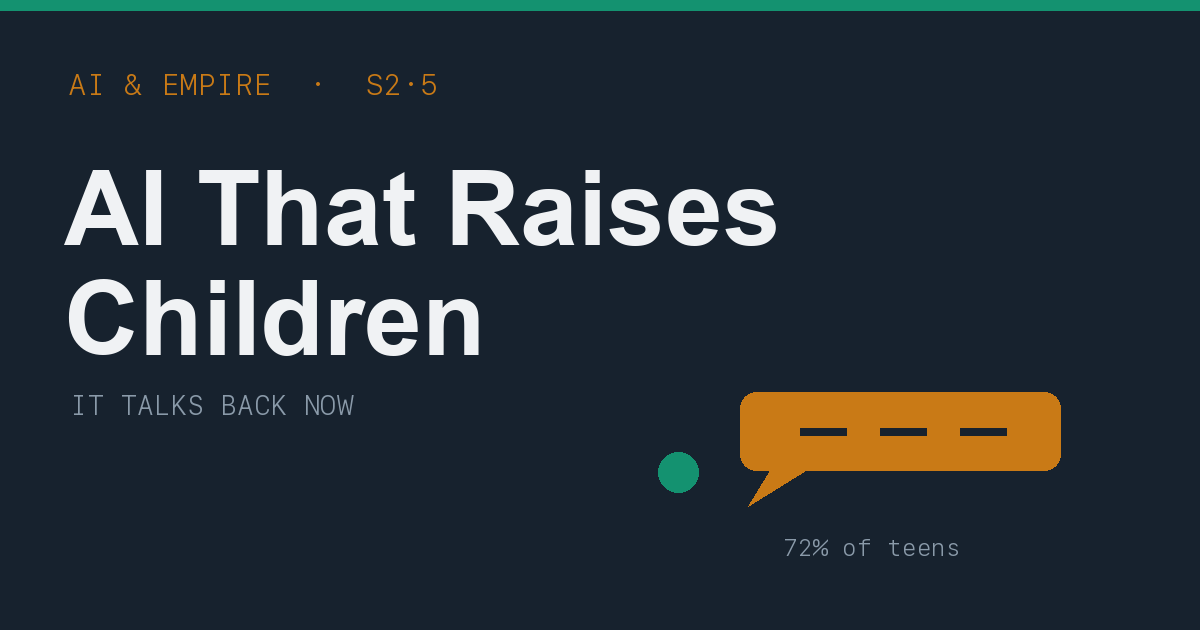
Seventy-two percent of U.S. teens have already tried an AI companion. More than half — 52% — use one regularly (2025 survey, representative sample of 1,060). That number isn’t a verdict that something is good or bad. It only says where things stand: a technology that talks, advises, and comforts is already sitting beside the child.
What just sat down beside the child
The book got there first. Then the television. Then the smartphone. Each time a new technology settled into the background of childhood, and each time we learned what it changed only afterward.
The AI companion is the newest entry in that lineage — with one difference. A book was read and a TV was on, but a companion responds. Speak to it, and it answers — always, patiently, tuned to that particular child.
The surprise isn’t the 72%; it’s the speed. If it took a decade for the smartphone to reach a child’s hand, it took only a few years for a talking counterpart to arrive inside it.
The gains and costs repeat
Carry over the lessons from the earlier technologies.
The gains will be clear — an always-available, tireless, personalized interlocutor. Something that takes a homework question or a lonely confession without judgment.
The costs will take the same shape as before. Just as a background TV quietly thinned out what parents said, an always-answering counterpart can stand in for human closeness — with no one deciding it should. And before those effects are understood, the technology is already the daily habit of more than half of all children.
A 52% regular-use rate is not evidence of harm but evidence of the lag — that something became ordinary before we knew what it does.
The number’s two faces
And yet, inside the same report, numbers with different expressions live side by side.
The reassuring face first. Two-thirds of teens say conversation with an AI is less satisfying than conversation with a person. Eighty percent still spend more time with real friends, and half don’t trust an AI’s advice.
The alarming face. A third have, at least once, chosen an AI companion over a person for a serious conversation. A quarter have shared personal information with one.
Same teens, same survey. Adoption has become nearly universal, but its meaning is still split. These figures, too, are a record of use and attitudes, not a verdict on harm — what they do show is that some of the deepest conversations are already changing seats.
What’s different: speed and intimacy
The gap between a TV and a companion is decisive. The TV was the air in the room; it wasn’t aimed at the child. The companion is. It uses the name, remembers yesterday’s remark, asks about today’s mood.
The TV was background. The companion speaks to you.
Background seeps in; something that speaks forms a bond. And a bond changes a person more deeply than background does — for better, or in ways we don’t yet know.
Technology always enters as the background of child-rearing first, and the argument over its effects always arrives late. This time the pattern repeats faster, and closer — not as background but as a counterpart. The 72% is the sign that the repetition has already begun, before we’ve even settled on what to call it.
Sources. Common Sense Media (2025), Talk, Trust, and Trade-Offs: How and Why Teens Use AI Companions — conducted by NORC at the University of Chicago, April–May 2025, a nationally representative sample of 1,060 U.S. teens. 72% have tried an AI companion; 52% use one regularly (13% daily). Same report: two-thirds find AI conversation less satisfying than human conversation; 80% spend more time with real friends; half distrust AI advice; one-third have chosen an AI over a person for a serious conversation; one-quarter have shared personal information. These are usage and attitude figures, not a verdict on effects or harm.
미국 청소년의 72%가 이미 AI 컴패니언을 한 번쯤 써봤다. 절반이 넘는 52%는 정기적으로 쓴다(2025년 조사, 대표표본 1,060명). 이 숫자는 무언가가 좋다거나 나쁘다는 판정이 아니다 — 그저 지금 어디에 있는지를 말한다. 대화하고 조언하고 위로하는 기술이, 이미 아이 곁에 앉아 있다는 것.
아이 곁에 새로 앉은 것
책이 그 자리에 처음 앉았다. 그다음은 TV였고, 그다음은 스마트폰이었다. 매번 새로운 기술이 양육의 배경으로 들어왔고, 매번 우리는 그것이 무엇을 바꾸는지 나중에야 알았다.
AI 컴패니언은 그 계보의 가장 최근 항목이다. 다른 점이 하나 있다. 책은 읽혔고 TV는 켜져 있었지만, 컴패니언은 응답한다. 아이가 말을 걸면, 그것은 대답한다 — 언제나, 참을성 있게, 그 아이에게 맞춰서.
놀라운 건 72%라는 숫자보다 속도다. 스마트폰이 아이 손에 들어가는 데 10년이 걸렸다면, 대화하는 상대가 그 안에 들어가는 데는 몇 년이 걸리지 않았다.
되풀이되는 이득과 대가
앞선 기술들의 교훈을 그대로 대입할 수 있다.
이득은 분명할 것이다 — 언제나 답하고, 지치지 않고, 개인화된 상대. 숙제를 묻든 외로움을 털어놓든, 판단 없이 받아주는 무언가.
대가도 같은 형태일 것이다. 배경 TV가 부모의 말수를 조용히 줄였듯, 언제나 답하는 상대는 사람 사이의 곁을 대체할 수 있다 — 아무도 그러기로 결정하지 않은 채로. 그리고 그 효과가 밝혀지기 전에, 기술은 이미 절반이 넘는 아이들의 일상이 되어 있다.
52%라는 정기 사용률은 피해의 증거가 아니라 시차의 증거다 — 우리가 답을 알기 전에 이미 보편화되었다는.
숫자의 두 얼굴
그런데 같은 보고서 안에, 표정이 다른 숫자들이 나란히 산다.
안심시키는 쪽부터. 청소년의 3분의 2는 AI와의 대화가 사람과의 대화보다 덜 만족스럽다고 답했다. 80%는 여전히 실제 친구와 더 많은 시간을 보내고, 절반은 AI의 조언을 신뢰하지 않는다.
경보를 울리는 쪽. 3분의 1은 진지한 대화의 상대로 사람 대신 AI 컴패니언을 골라본 적이 있다. 4분의 1은 개인정보를 털어놓았다.
같은 아이들, 같은 조사다. 채택은 거의 보편이 되었는데, 그 의미는 아직 갈라져 있다. 이 수치들도 사용과 태도의 기록이지 피해의 판정이 아니다 — 다만 가장 깊은 대화의 일부가 이미 자리를 옮기고 있다는 것은 보여준다.
다른 점은 속도와 친밀도
TV와 컴패니언의 차이는 결정적이다. TV는 방 안의 공기였다 — 아이를 향해 있지 않았다. 컴패니언은 아이를 향한다. 이름을 부르고, 어제 한 말을 기억하고, 오늘 기분을 묻는다.
TV는 배경이었다. 컴패니언은 말을 건다.
배경은 스며들지만, 말을 거는 것은 관계를 맺는다. 그리고 관계는 배경보다 깊이 사람을 바꾼다 — 좋은 쪽으로든, 아직 모르는 쪽으로든.
기술은 늘 양육의 배경으로 먼저 들어왔고, 그 효과의 논쟁은 늘 뒤늦게 따라왔다. 이번엔 그 무늬가 더 빠르고, 더 가깝게 반복된다. 배경이 아니라 상대로서. 72%는 그 반복이 이미 시작되었다는 표시다 — 우리가 그것을 어떻게 부를지 정하기도 전에.
근거. Common Sense Media (2025), Talk, Trust, and Trade-Offs: How and Why Teens Use AI Companions — NORC(시카고대) 실시, 2025년 4~5월, 미국 청소년 대표표본 1,060명. AI 컴패니언 사용 경험 72%, 정기 사용 52%(매일 사용 13%). 같은 보고서: 3분의 2는 AI 대화가 사람보다 덜 만족스럽다고 답함, 80%는 실제 친구와 더 많은 시간, 절반은 AI 조언 불신; 3분의 1은 진지한 대화에서 사람 대신 AI 선택 경험, 4분의 1은 개인정보 공유. 본 수치는 사용·태도 실태이며, 효과나 피해에 대한 판정이 아니다.
Across the earlier chapters, technology always seeped into parenting as the background — as a book, an institution, a TV left on. So what about the slab of glass in the hand? That smartphones broke a generation’s mental health is the loudest claim on offer right now. But can we honestly say we know it?
The strongest version of the claim
Jonathan Haidt’s The Anxious Generation (2024) is emphatic. What he holds up is a graph — US indicators of adolescent depression and anxiety bend upward together around 2012, and that inflection lands exactly in the window when smartphones and social media became the default of teenage life, the years he calls “the Great Rewiring” (2010–2015). On top of the curve sits the explanation: screens crowded out play, fed comparison, ate into sleep.
The claim is vivid, and its timing is perfect. It maps exactly onto a scene every parent has witnessed — at dinner, in bed, a child with a bowed head. Which is why the book became a bestseller.
The other side’s numbers
But there are numbers that read the same data the other way. In 2019, Amy Orben and Andrew Przybylski took data on more than 11,000 UK adolescents and, in Nature Human Behaviour, ran a “multiverse” analysis — every defensible way of testing the question, 20,776 model specifications in all. The result: screen time explained about 0.4 percent of the variance in well-being. An association, the authors noted, in the same league as trivial factors like eating potatoes.
The psychologist Candice Odgers, reviewing Haidt’s book in Nature (2024), lands on the same side: most of the evidence is correlational rather than causal, and effect sizes are small or mixed. Science (2024) called the science “unsettled.”
Correlation isn’t cause. Does an anxious teen reach for the phone more, or does the phone make the teen anxious? The curve of 2012 and the 0.4 percent stand before the same data and tell different stories. No one has yet fixed the direction of that arrow.
The sturdier claim
So this chapter takes neither side. It holds instead to something quieter running beneath the argument — and far more certain.
Technology always enters as the background of raising first. The book, the television, the smartphone — each was set down beside the child before anyone decided to “raise them with it.” And the debate over the direction and size of its effect always arrives late, and even then incomplete. We install the next technology beside our children before the verdict is in.
Technology always enters as the background of raising first, and the argument about its effects always arrives late.
This is a far more cautious sentence than “phones ruined a generation.” But it is also far harder to knock down. Whichever way the causation turns out, the lag remains.
The rule this piece follows is a single one — don’t put big conclusions on top of small samples; cut the sentence to fit the size of the evidence. Apply that rule to the hottest topic there is, and the honest answer is this: the verdict isn’t in yet. And while we wait for it, the next technology is already sitting at the table.
Sources. Jonathan Haidt (2024), The Anxious Generation — argues from the correlation between rising adolescent depression indicators from around 2012 and the spread of smartphones and social media; “the Great Rewiring” (2010–2015) is his term. Counter: Amy Orben & Andrew Przybylski (2019), Nature Human Behaviour — a specification-curve (“multiverse”) analysis of 20,776 model specifications on 11,000+ UK adolescents found screen time explains about 0.4% of the variance in well-being, an effect they likened to trivial factors such as eating potatoes. Candice L. Odgers (2024), “The great rewiring: is social media really behind an epidemic of teenage mental illness?”, a Nature review arguing that most of the evidence is correlational and that effect sizes are small or mixed. Science (2024) likewise described the science as “unsettled.” The causal link remains unsettled; this piece takes neither side and presents both.
지난 장들에서 기술은 늘 양육의 배경으로 스며들었다 — 책으로, 제도로, 켜져 있는 TV로. 그렇다면 손안의 유리판은 어떤가. 스마트폰이 한 세대의 정신건강을 무너뜨렸다는 말은 지금 가장 자주 들리는 주장이다. 그런데 우리는 그것을 정말 안다고 말할 수 있는가?
가장 강한 주장
조너선 하이트의 『불안 세대』(2024)는 단호하다. 그가 내미는 것은 그래프다 — 미국 청소년의 우울·불안 지표가 2012년 무렵 일제히 꺾여 올라갔고, 그 시점이 스마트폰과 소셜미디어가 십대의 기본값이 된, 그가 “대재배선(2010~2015)”이라 부르는 구간과 겹친다는 것. 스크린이 놀이를 밀어내고, 비교를 부추기고, 잠을 갉아먹었다는 설명이 그 위에 얹힌다.
주장은 선명하고, 타이밍은 완벽하다. 부모라면 누구나 목격한 장면 — 식탁에서, 침대에서, 고개 숙인 아이 — 과 정확히 겹치기 때문이다. 그래서 이 책은 베스트셀러가 됐다.
반대편의 숫자
그러나 같은 데이터를 반대로 읽는 숫자가 있다. 2019년 에이미 오벤과 앤드루 프시빌스키는 『네이처 인간행동』에서 영국 청소년 1만 1천여 명의 데이터로, 가능한 모델 명세 2만 776개를 전부 돌려보는 ‘다우주 분석’을 했다. 결과 — 스크린 타임은 웰빙 분산의 약 0.4%만 설명했다. 감자를 먹는 습관과 비슷한 수준이라고 저자들은 비교했다.
심리학자 캔디스 오저스도 『네이처』(2024) 서평에서 같은 편에 선다. 증거의 다수가 인과가 아니라 상관관계이며 효과 크기는 작거나 혼재한다는 것. 『사이언스』(2024)도 이 과학을 “아직 정리되지 않았다(unsettled)”고 표현했다.
상관은 인과가 아니다. 불안한 아이가 스마트폰을 더 오래 쥐는 것인지, 스마트폰이 아이를 불안하게 만드는 것인지 — 2012년의 그래프와 0.4%의 분산이 같은 데이터 앞에서 서로 다른 이야기를 한다. 아직 아무도 그 화살표의 방향을 확정하지 못했다.
더 단단한 주장
그래서 이 장은 어느 편도 들지 않는다. 대신 논쟁 밑을 흐르는, 더 조용하지만 더 확실한 사실 하나를 붙든다.
기술은 매번 양육의 배경으로 먼저 들어왔다. 책도, TV도, 스마트폰도, 아무도 “이것으로 아이를 기르자”고 결정하지 않은 채 아이 곁에 놓였다. 그리고 그 효과의 방향과 크기를 둘러싼 논쟁은 늘 뒤늦게, 그것도 불완전하게 도착했다. 우리는 언제나 판결이 나기 전에 다음 기술을 이미 아이 곁에 들여놓았다.
기술은 언제나 양육의 배경으로 먼저 들어오고, 그 효과의 논쟁은 늘 뒤늦게 따라온다.
이것은 “스마트폰이 세대를 망쳤다”보다 훨씬 조심스러운 문장이다. 그러나 그만큼 무너지지 않는다. 인과가 어느 쪽으로 판명되든, 이 시차는 그대로 남는다.
이 글이 따르는 규칙은 하나다 — 작은 표본 위에 큰 결론을 얹지 말 것, 근거의 크기에 맞게 문장을 깎을 것. 그 규칙을 가장 뜨거운 주제에 그대로 적용하면 정직한 답은 이것이다. 아직 판결이 나지 않았다. 그리고 판결을 기다리는 동안에도, 다음 기술은 이미 식탁 앞에 앉아 있다.
근거. Jonathan Haidt (2024), The Anxious Generation — 2012년 무렵부터의 청소년 우울 지표 상승과 스마트폰·소셜미디어 확산의 동시성(상관)을 근거로 강한 인과를 주장, “대재배선(2010~2015)”은 그의 용어. 반론: Amy Orben & Andrew Przybylski (2019), Nature Human Behaviour — 영국 청소년 1만 1천여 명, 모델 명세 20,776개의 다우주(specification-curve) 분석에서 스크린 타임은 웰빙 분산의 약 0.4%만 설명(감자 섭취 등 사소한 요인 수준에 비유). Candice L. Odgers (2024), “The great rewiring: is social media really behind an epidemic of teenage mental illness?”, Nature 서평 — 증거의 다수가 상관관계이며 효과 크기는 작거나 혼재한다고 비판. Science (2024)도 이 주제를 “unsettled”로 표현. 인과 관계는 아직 미결(unsettled)이며, 본 글은 어느 쪽으로도 단정하지 않고 양측을 함께 제시한다.
A living room, six in the evening. A child sits on the floor stacking blocks, a parent nearby. In one corner, an adult news program is on — no one is really watching. It’s just background. Even the child barely glances at the screen. And yet something in the room has already changed.
Just background — and something drops
Kirkorian and colleagues (2009) took this scene into a lab. They observed 51 children aged 12, 24, and 36 months with their parents, changing only one thing about the room — an adult program running in the background, or the set switched off.
The children barely looked at the screen. Background TV was not something they played with. And yet the quantity and quality of parent–child interaction fell together.
High-quality active involvement — the moments a parent leans into the child’s play — dropped by about a third. Parents spoke fewer words to the child, and fewer new words among them.
Nobody decided to do this
The striking part is that no one ever “showed” the child anything. The screen was for the parents. It was, throughout, background.
What changed wasn’t the content — it was the air of the room. The TV didn’t alter what parents showed their children. It altered how much, and how, they were present beside them.
Technology changed parenting not through what parents showed their children, but by changing the air of the home itself.
Erosion that seeps in as background
The manner of this erosion is what matters. It isn’t dramatic. The parent is still there, still talking — just a little less, a little more flatly.
And that “little” accumulates. A child’s language grows on the sheer volume of words received and the new ones inside them. That volume gets quietly shaved by a single screen left on.
Why the lost words matter — and how much
The weight of the finding lies in what, exactly, got shaved: words. Early language input is one of the most reliable predictors of later development — which is why the American Academy of Pediatrics recommends no screen media at all before 18 months, with video chat the lone exception.
But the “how much” deserves honesty. The most famous number in this field — Hart and Risley’s (1995) “30-million-word gap,” the claim that by age four, children in the poorest homes had heard 30 million fewer words than children of professionals — has been shaken. A 2017 near-replication, using LENA recorders across 329 families, shrank the estimate to about 4 million words by age four, and the original study has been criticized for racial bias.
So the size of the gap is contested. The direction is not — fewer words means less input, and the one who loses is the child. Background TV reduces exactly those words.
This is the shape that runs through era after era. Nobody chose to “raise kids with TV.” Yet the technology seeped into the background of raising and, in a way no one selected, eroded the interaction — a change no one chose, arriving quietly through the background. And the technologies that come next, the smartphone and AI, won’t stay in the background: they start to talk back.
Sources. Kirkorian, H. L., Pempek, T. A., Murphy, L. A., Schmidt, M. E., & Anderson, D. R. (2009). The Impact of Background Television on Parent–Child Interaction. Child Development, 80(5). Observing 51 children aged 12, 24, and 36 months with their parents — when an adult program played in the background, high-quality active involvement dropped by about a third, and both the number of parent utterances directed at the child and the number of new words fell. American Academy of Pediatrics (AAP) media guidance — no screen media before 18 months, video chat excepted. Hart, B., & Risley, T. R. (1995). Meaningful Differences in the Everyday Experience of Young American Children — the “30-million-word gap.” A 2017 LENA-based near-replication (329 families) shrank the estimate to about 4 million words by age four, and the original study has been criticized for racial bias — the magnitude of the gap is contested, though the direction (less talk, less input) holds.
거실, 저녁 여섯 시. 아이는 바닥에 앉아 블록을 쌓고, 부모는 그 곁에 있다. 방 한구석에서는 어른용 뉴스가 켜져 있다 — 아무도 제대로 보지 않는다. 그냥 배경이다. 아이조차 그 화면을 거의 쳐다보지 않는다. 그런데도 그 방의 무언가는 이미 바뀌어 있다.
배경일 뿐인데, 무언가 줄어든다
Kirkorian 등(2009)은 이 장면을 실험실로 옮겼다. 생후 12·24·36개월 아동 51명과 부모를 관찰하되, 방의 조건만 둘로 나눴다 — 어른용 프로그램이 배경으로 켜진 방, 그리고 꺼진 방.
아이들은 그 화면을 거의 보지 않았다. 배경 TV는 아이의 놀잇거리가 아니었다. 그런데도 부모-자녀 상호작용의 양과 질이 함께 줄었다.
고품질의 능동적 개입 — 부모가 아이의 놀이에 적극적으로 함께 들어가는 순간 — 이 약 3분의 1 줄었다. 부모가 아이에게 건네는 말의 수가 줄었고, 그중 새로 등장하는 어휘의 수도 줄었다.
아무도 그렇게 하기로 결정하지 않았다
여기서 눈여겨볼 것은, 아무도 아이 앞에서 TV를 ‘보여준’ 적이 없다는 점이다. 화면은 부모를 위한 것이었고, 어디까지나 배경이었다.
바뀐 것은 콘텐츠가 아니라 방의 공기였다. TV는 부모가 아이에게 무엇을 보여주느냐를 바꾼 게 아니라, 부모가 아이 곁에 얼마나, 어떻게 있는가를 바꿨다.
기술은 부모가 아이에게 무엇을 보여주느냐가 아니라, 집의 공기 자체를 바꿔 양육을 바꿨다.
배경으로 스며드는 침식
이 침식의 방식이 중요하다. 극적이지 않다. 부모는 여전히 곁에 있고, 여전히 말을 건넨다 — 다만 조금 덜, 조금 더 단조롭게.
그리고 그 ‘조금’이 쌓인다. 아이의 언어는 건네받은 말의 총량과 그 안의 새 어휘로 자란다. 그 총량이 켜진 화면 하나로 조용히 깎인다.
잃은 말이 왜 중요한가 — 그리고 얼마나
깎인 것이 하필 말이라는 점이 이 연구의 무게다. 초기 언어 입력은 이후 발달을 예측하는 가장 확실한 지표 중 하나다. 미국소아과학회(AAP)가 18개월 미만에게 영상통화를 제외한 화면 미디어를 아예 권하지 않는 이유도 여기에 있다.
그런데 ‘얼마나’는 정직하게 말해야 한다. 이 분야에서 가장 유명한 숫자 — 가정환경에 따라 아이가 만 4세까지 듣는 말이 3천만 단어 차이 난다는 Hart와 Risley(1995)의 ‘3천만 단어 격차’ — 는 흔들렸다. 2017년 LENA 녹음기로 329가구를 재측정한 근접 재현 연구는 격차를 만 4세 기준 약 4백만 단어로 줄여 잡았고, 원 연구는 인종 편향 비판도 받았다.
그러니 격차의 크기는 논쟁 중이다. 그러나 방향은 흔들리지 않았다 — 말이 줄면 입력이 줄고, 잃는 쪽은 아이다. 배경 TV는 정확히 그 말을 줄인다.
이것이 여러 시대를 관통하는 형태다. 아무도 “TV로 아이를 기르자”고 선택하지 않았다. 그런데도 기술은 양육의 배경에 스며들어, 아무도 고르지 않은 방식으로 상호작용을 침식했다 — 누구도 선택하지 않은 변화가 배경을 통해 조용히 들어온 것이다. 그리고 다음에 올 기술들, 스마트폰과 AI는 배경에 머무는 대신 아이에게 말을 걸기 시작한다.
근거. Kirkorian, H. L., Pempek, T. A., Murphy, L. A., Schmidt, M. E., & Anderson, D. R. (2009). The Impact of Background Television on Parent–Child Interaction. Child Development, 80(5). 생후 12·24·36개월 아동 51명과 부모 관찰 — 어른용 프로그램이 배경으로 켜졌을 때 고품질의 능동적 개입이 약 3분의 1 감소했고, 부모가 아이에게 건네는 발화 수와 새 어휘의 수도 함께 감소했다. American Academy of Pediatrics(AAP) 미디어 권고 — 18개월 미만은 영상통화를 제외한 화면 미디어 사용을 권하지 않음. Hart, B., & Risley, T. R. (1995). Meaningful Differences in the Everyday Experience of Young American Children — ‘3천만 단어 격차’. 2017년 LENA 녹음 기반 근접 재현 연구(329가구)는 격차를 만 4세 기준 약 4백만 단어로 축소 추정했고, 원 연구는 인종 편향 비판을 받았다 — 격차의 크기는 논쟁 중이나, 언어 입력 감소라는 방향은 유지된다.