AI에 관한 대부분의 글은 생산성 수치에서 멈춘다. AI가 이 작업을 40% 빠르게 만들었다. 보통 이야기는 거기서 끝난다. 나는 흥미로운 부분이 바로 거기서 시작한다고 생각한다.
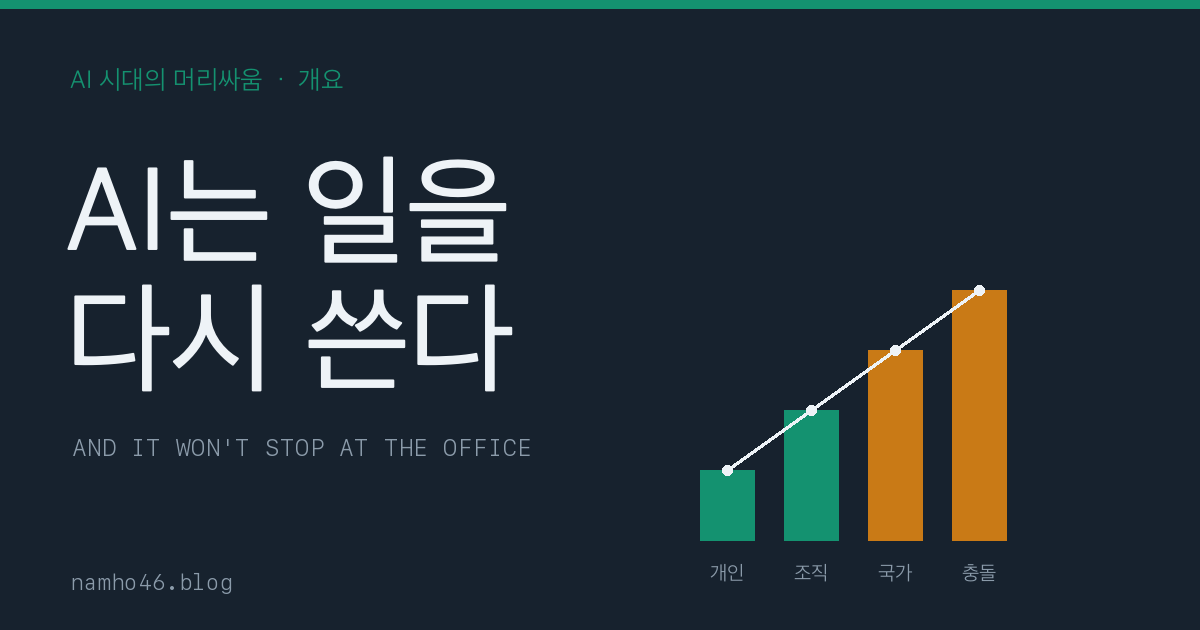
생산성의 향상은 결코 한자리에 머물지 않기 때문이다. 그것은 움직인다. 한 사람의 책상에서 회사의 모양으로, 다시 국가가 경쟁하는 방식으로, 그리고 — 역사가 말해준다면 — 충돌의 문법으로까지 번져 올라간다. 이 페이지는 그 여정의 지도다. 아래 각 정거장은 짧은 요약이고, “→” 링크가 연구에 근거한 각 챕터의 전문을 연다.
두 노동자 사이의 격차에서 시작한다
AI가 처음 바꾸는 것은 산출물이 아니다. 누가 그것을 만드는가다.
2023년 MIT 실험에서 AI를 쓴 전문직은 작업 시간을 40% 줄이고 품질을 18% 높였다. 그러나 놀라운 발견은 분포 속에 숨어 있었다 — 하위 성과자들의 향상폭이 가장 컸다. Fortune 500 콜센터 연구도 같은 결과를 냈다. 전체 평균 14% 향상, 그러나 하위 숙련군은 34%. 연구진은 이를 스킬 압축이라 불렀다. AI는 천장보다 바닥을 더 빠르게 끌어올린다.
30년간 경험은 성과의 가장 강력한 예측 변수였다. 스킬 압축은 그 공식에 균열을 낸다 — 그리고 조직이 사람을 채용하고, 붙잡고, 내보낼 때 무엇을 사고파는지를 조용히 바꾼다.
바닥이 올라가면, 다음 질문이 모든 경영 회의에 등장한다. 더 적은 인원으로 같은 성과를 낼 수 있는 것 아닌가?
여기서 생산성 이야기는 인재 이야기로 바뀐다. 한 사람이 떠날 때 함께 나가는 가치 — 암묵지, 고객을 읽는 감각, 실패에서 걸러낸 직관 — 는 AI 시대에 오히려 더 이동 가능해진다. 그 일부가 이제 프롬프트와 워크플로에 남아 사람과 함께 움직이기 때문이다. 효율을 얻으려 인재를 내보내는 것은 그 효율을 조용히 경쟁사에 넘기는 일이 될 수 있다.
AI 경쟁을 결정하는 자원 — 고품질 데이터, 첨단 반도체, 프런티어 인재 — 은 인터넷과 다르다. 인터넷은 모두가 쓸수록 가치가 커지지만, 이 자원들은 제로섬에 가깝다. 한쪽이 확보하면 다른 쪽은 그만큼 잃는다. 그 지점에서 한 기업의 AI 역량은 한 국가의 역량으로 읽히고, “인재를 지키는 일”은 기술 주권의 문제가 된다.
여기서 생산성 이야기는 예상 밖의 곳에 도착한다 — 그리고 이것이 대부분의 보도가 놓치는 줄기다.
전기와 인터넷은 소유자를 자동으로 무장시키지 않으며 퍼졌다. AI는 한 가지 결정적인 점에서 다르다. 이중 사용(dual-use)이다. 민간 도구가 수십 년이 아니라 수개월 만에 군사용으로 전환된다. RAND는 그 경로를 기록한다 — 컴퓨터 비전 AI가 타격 드론 제어로, 고객 서비스 언어 모델이 허위정보 도구로. 그리고 이것은 이론이 아니다. 우크라이나에서, 상업용 부품과 오픈소스로 만든 드론이 전선 사상자의 약 70~80%와 얽혀 있다.
냉전은 대부분이 잊은 본보기를 남겼다. 초강대국들은 핵탄두를 쌓으면서 동시에 핫라인, 핵비확산조약, 군축 협상을 만들었다. 억지와 규범이 함께 작동했다. AI 시대에도 두 축이 필요하다 — 내부 역량 그리고 경쟁을 관리 가능하게 유지하는 규범. 이 시리즈가 향해 가는 논지다.
나는 한국에 사는 개발자이고 매일 AI를 쓴다. 그렇게 매일 쓰다 보니 떨쳐지지 않는 질문이 생겼다 — 이건 대체 어디로 가고 있을까? 이 블로그는 그 질문에 조심스럽게 답해보려는 시도다 — 연구를 읽고, 하나의 논문에서 시작한 선을 조직과 국가까지 따라가며, 짧은 챕터로 하나씩 적어 나간다.
위 지도가 흥미롭다면 링크를 따라 각 챕터로 들어가거나, 소개 페이지부터 시작해도 좋다. 새 챕터는 일정한 간격으로 올라오고, 이 페이지도 그와 함께 자라난다.
New chapters land on a regular cadence. Subscribe to get each one by email.
Most writing about AI stops at the productivity number: AI made this task 40% faster. That’s where the story usually ends. I think it’s where the interesting part begins.
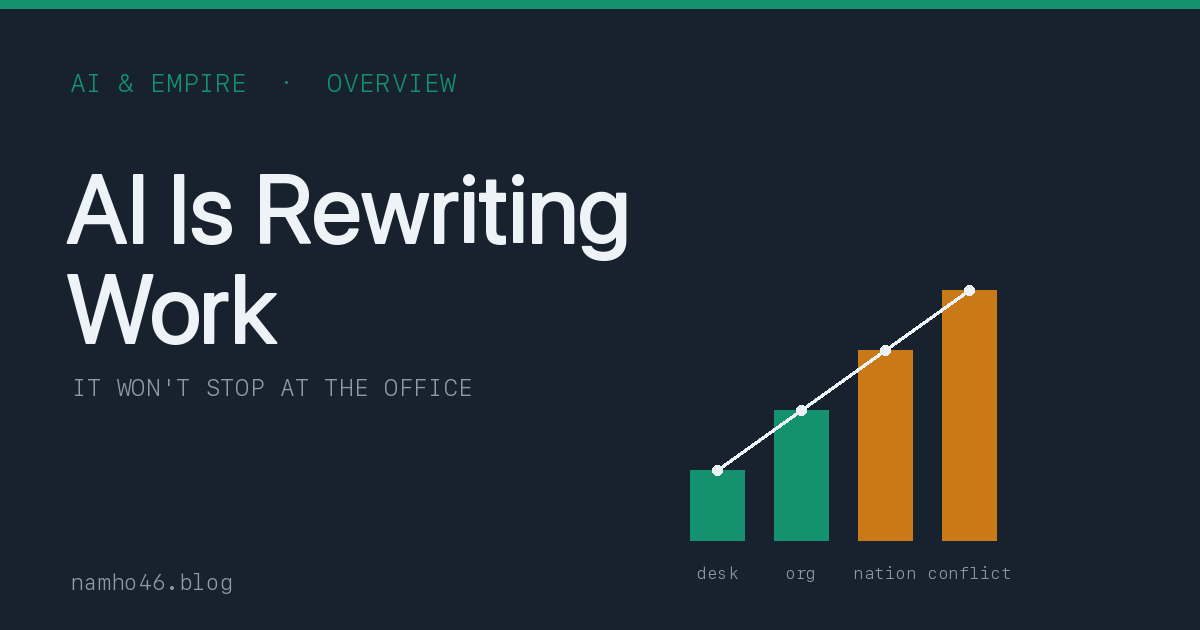
Because a productivity gain never stays put. It moves. It travels up from a single person’s desk to the shape of a company, then to how nations compete, and — if history is any guide — to the grammar of conflict itself. This page is the map of that journey. Each stop below is a short summary; the “→” links open the full chapter, each one grounded in the research.
It starts with a gap between two workers
The first thing AI changes isn’t output. It’s who produces it.
In a 2023 MIT experiment, professionals using AI cut task time by 40% and raised quality by 18%. But the striking finding was hidden in the distribution: the lowest performers improved the most. A Fortune 500 call-center study found the same — a 14% average gain, but 34% for the least-skilled group. Researchers named it skill compression: AI raises the floor faster than the ceiling.
For thirty years, experience was the strongest predictor of performance. Skill compression cracks that formula — and quietly changes what an organization is buying when it hires, keeps, or lets go of people.
Once the floor rises, the next question lands in every management meeting: can we do the same with fewer people?
That’s where the productivity story turns into a talent story. The value that walks out the door when someone leaves — the tacit knowledge, the read on a customer, the instinct filtered from past failure — gets more portable in the AI era, not less, because some of it now lives in prompts and workflows a person can take with them. Cutting talent to bank an efficiency gain can quietly hand that gain to a competitor.
Scale the same logic up one more level and it stops being about companies.
The resources that decide the AI race — high-quality data, advanced chips, frontier talent — are not like the internet, where everyone using it makes it more valuable. They’re closer to zero-sum: what one side secures, another is denied. At that point a company’s AI capacity reads as a country’s capacity, and “keeping your talent” becomes a question of technological sovereignty.
Here the productivity story arrives somewhere unexpected — and this is the throughline most coverage misses.
Electricity and the internet spread without automatically arming their owners. AI is different in one decisive way: it is dual-use. A civilian tool converts to a military one in months, not decades. RAND documents the paths — computer-vision AI to strike-drone control, a customer-service language model to disinformation tooling. And it isn’t theoretical: in Ukraine, drones built from commercial parts and open-source software are tied to roughly 70–80% of frontline casualties.
The line between a productivity tool and a weapon is being erased — not in theory, but already in reality.
If every actor simply hoards talent and capability, you get another round of leveling — and, by the logic above, another basis for conflict. So strength alone isn’t the answer.
The Cold War offers the template most people forget: the superpowers stacked warheads and built hotlines, non-proliferation treaties, and arms-control talks at the same time. Deterrence and norms worked together. The AI era needs both axes too — internal capability and the norms to keep competition manageable. That’s the argument the series builds toward.
I’m a developer in Korea who uses AI every day, and that daily use left me with a question I couldn’t shake: where is this all heading? This blog is me trying to answer it carefully — reading the research, following the line from one study out to organizations and nations, and publishing it one short chapter at a time.
If the map above is interesting, follow the links into the chapters, or start with the about page. New chapters land on a regular cadence — and this page will grow as they do.
In the late twentieth century, as dual-income households grew and childcare centers spread, raising moved — from the home into institutions. An old worry followed close behind: does leaving a child in care for long hours cost something? One study answered that question with data instead of instinct.
Raising moved into institutions
The NICHD followed this shift with a large longitudinal study. It tracked children across many sites, from birth into the school years, measuring how childcare shaped their development.
Why that design matters is simple. The effects of care don’t show up in a year or two, and small samples can’t be told apart from chance.
And its conclusion cut against the common worry. The question wasn’t “how long.”
Quality, not quantity
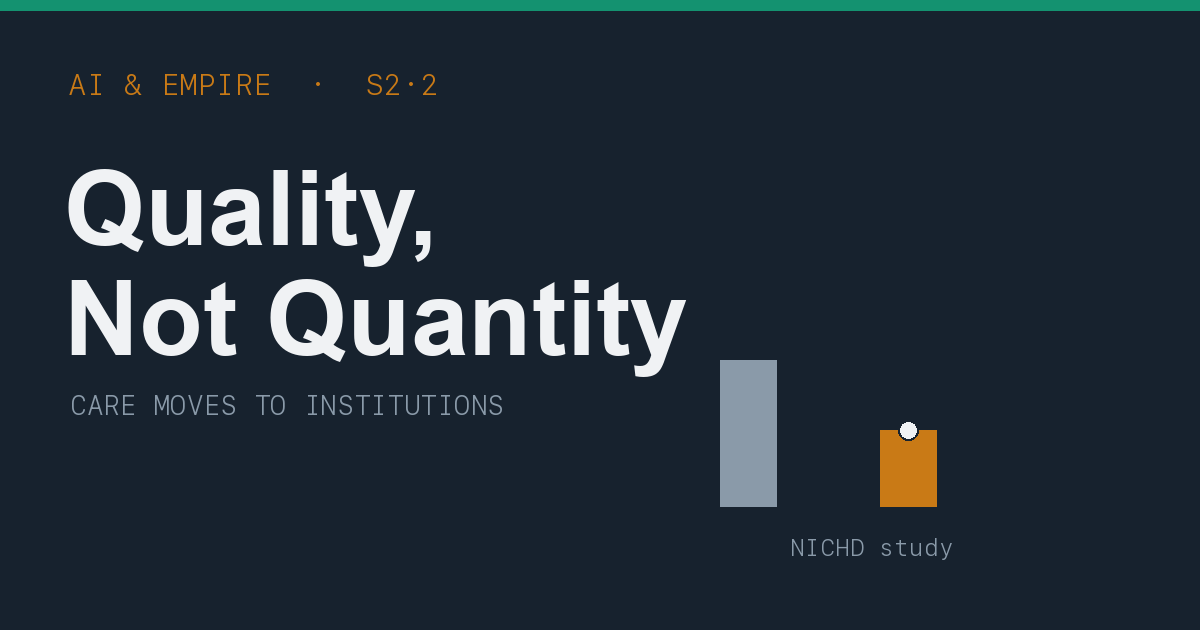
The central finding fits in one line — what mattered was not the amount of time but the quality of care.
Children in high-quality care showed better cognitive, language, and school-readiness outcomes. Long hours, meanwhile, showed a weak association with early behavior problems — a weak association, not a strong cause.
And over all of it sat one moderator: maternal sensitivity. The relationship at home filtered or amplified what the institution did. The institution didn’t replace the home; the two worked together.
Quality pays — if you can get it
So what happens if you push quality all the way up? The economist James Heckman tracked that answer across decades.
Perry Preschool and Abecedarian — intensive, high-quality programs designed to run from birth to age five. In Heckman’s analysis, they returned 7 to 13 percent per year on the money invested, decades later — paid back in better education and employment, better health, and less crime.
But that number carries a footnote. The 7 to 13 percent belongs to research-grade, intensive programs. Most real-world childcare never reaches that level of quality. “Quality decides” therefore cuts both ways — quality pays, enormously. But that kind of quality is rare.
The effects are modest — and that’s the point
Here the season sets its rule. The effects the NICHD found in the ordinary range of care were real but mostly modest, while Heckman’s large returns belonged to rare, intensive programs. The two numbers don’t contradict each other; they are two sides of the same picture.
That modesty isn’t a disappointing result; it’s an honest one. Neither calling high-quality care a cure-all nor long hours a catastrophe — saying only as much as the data allows.
What mattered was quality, not quantity, and even those effects were modest. Neither fear nor praise runs ahead of the data.
Here the principle this season will keep is set. Raising is the handing-down, generation to generation, of a tacit knowledge no document holds — its effects are hard to see, and the measurement is always incomplete. So we trim our sentences to the size of the evidence. “Quality decides,” “the effects are modest,” “that kind of quality is rare” — neither fear nor praise runs ahead of the data.
Sources. NICHD Early Child Care Research Network, Study of Early Child Care and Youth Development. Key findings: the quality of care had a modest positive effect on cognitive, language, and school-readiness outcomes; long hours in care showed a weak association with early behavior problems; effect sizes were generally modest; and maternal sensitivity moderated the outcomes. (Summaries: Reading Rockets; follow-up papers via PMC.) James J. Heckman’s research on early-childhood investment (The Heckman Equation) — high-quality, intensive birth-to-five programs such as Perry Preschool and Abecedarian returned 7–13% per year (gains in education, employment, and health; reductions in crime).
20세기 후반, 맞벌이가 늘고 보육 시설이 퍼지면서 양육은 자리를 옮겼다 — 가정에서 제도로. 그러자 오래된 불안이 따라붙었다. 아이를 오래 맡기면 무언가 잃는 것은 아닐까? 이 질문에 감이 아니라 데이터로 답한 연구가 있다.
양육이 제도로 옮겨갔다
미 국립아동보건연구소(NICHD)는 대규모 종단연구로 이 변화를 추적했다. 여러 지역의 아동을 태어난 시점부터 학령기까지 따라가며, 보육이 발달에 미치는 영향을 측정했다.
이런 설계가 중요한 이유는 단순하다. 보육의 효과는 한두 해로는 보이지 않고, 표본이 작으면 우연과 구별되지 않는다.
그 연구가 내린 결론은 통념과 결이 달랐다. 문제는 ‘얼마나 오래’가 아니었다.
양이 아니라 질
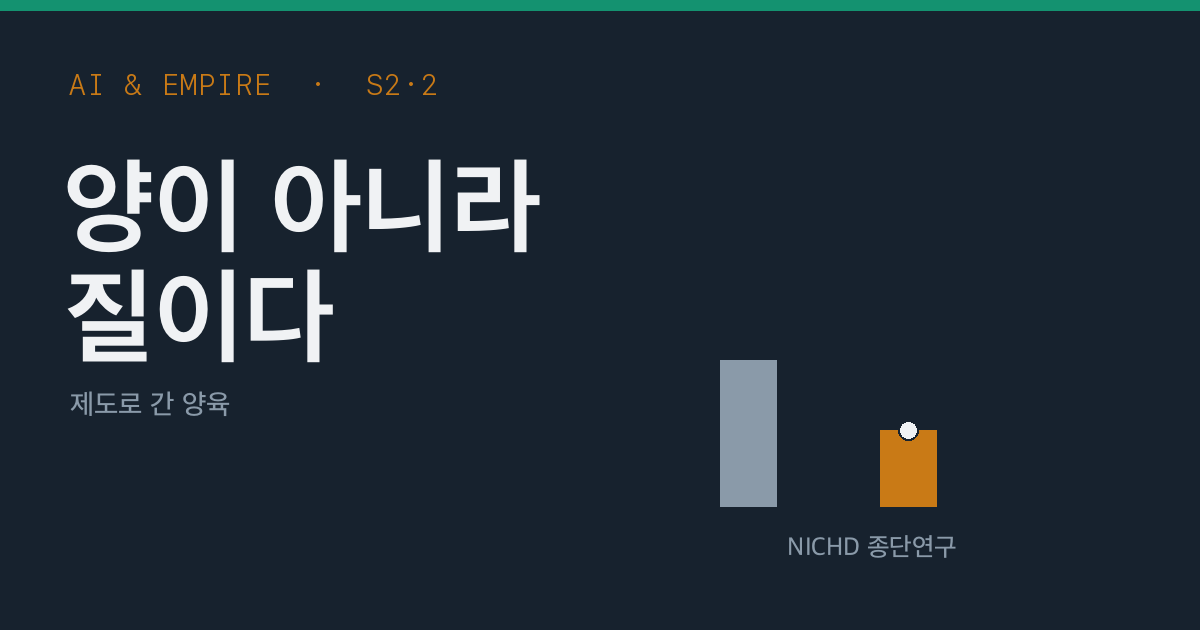
핵심 발견은 한 줄로 요약된다 — 중요한 것은 시간의 양이 아니라 보육의 질이었다.
고품질 보육을 받은 아이들은 인지·언어·학교 준비도에서 더 나은 결과를 보였다. 반면 장시간 보육은 초기 문제행동과 약한 연관을 보였다 — 강한 인과가 아니라 약한 연관이다.
그리고 이 모든 효과 위에 하나의 조절 변수가 있었다. 어머니의 민감성이다. 가정에서의 관계가 제도의 영향을 걸러내거나 키웠다. 제도가 가정을 대체한 것이 아니라, 둘이 함께 작동했다.
질은 값을 한다 — 구할 수 있다면
그렇다면 질을 끝까지 끌어올리면 어떻게 되는가. 경제학자 제임스 헤크먼이 그 답을 수십 년 단위로 추적했다.
페리 프리스쿨과 아베세다리안 — 출생부터 다섯 살까지를 집중 설계한 고품질 프로그램들이다. 헤크먼의 분석에서 이 프로그램들은 수십 년 뒤 연 7~13%의 투자수익률을 냈다 — 더 나은 교육과 고용, 더 나은 건강, 더 적은 범죄로 돌아온 수익이다.
그런데 그 숫자에는 각주가 붙는다. 연 7~13%는 연구급 집중 프로그램의 수익률이다. 현실의 보육 다수는 그 수준의 질에 이르지 못한다. ‘질이 좌우한다’는 결론은 그래서 양날이다 — 질은 값을 한다, 엄청나게. 그러나 그런 질은 드물다.
효과는 완만하다 — 그리고 그게 핵심이다
여기서 이 시즌이 지킬 규칙이 정해진다. NICHD가 일상 보육의 편차에서 찾은 효과는 실재했지만 대체로 완만했고(modest), 헤크먼의 큰 수익률은 드문 집중 프로그램의 것이었다. 두 숫자는 모순이 아니라 같은 그림의 양면이다.
이 완만함은 실망스러운 결과가 아니라 정직한 결과다. 고품질 보육을 만병통치약으로 부르지도, 장시간 보육을 재앙으로 부르지도 않는 것 — 데이터가 허락한 딱 그만큼만 말하는 것이다.
중요한 것은 양이 아니라 질이었고, 그 효과마저 완만했다. 공포도 찬양도 데이터보다 앞서지 않는다.
여기서 이 시즌이 지킬 원칙이 선다. 양육이란 문서에 없는 암묵지를 세대에서 세대로 건네는 일이고 — 그 전수의 효과는 눈에 잘 띄지 않으며, 측정은 늘 불완전하다. 그래서 우리는 문장을 근거의 크기에 맞게 깎는다. ‘질이 좌우한다’, ‘효과는 완만하다’, ‘그런 질은 드물다’ — 공포도 찬양도 데이터보다 앞서지 않는다.
근거. NICHD Early Child Care Research Network, Study of Early Child Care and Youth Development(미 국립아동보건연구소 종단연구). 주요 발견: 보육의 ‘질’이 인지·언어·학교 준비도에 완만한 긍정 효과, 장시간 보육은 초기 문제행동과 약한 연관, 효과크기는 대체로 modest, 어머니의 민감성이 조절 변수. (요약: Reading Rockets; 후속 논문 PMC.) James J. Heckman의 영유아 투자 연구(The Heckman Equation) — Perry Preschool·Abecedarian 등 출생~5세 고품질 집중 프로그램의 연 7~13% 투자수익률(교육·고용·건강 개선, 범죄 감소).
One baby-care book outsold every title of its century in America except the Bible. Benjamin Spock’s The Common Sense Book of Baby and Child Care (1946): 500,000 copies in six months, roughly 50 million by 1998. The number isn’t a sales record. It marks the moment a generation’s answer to one question — what do we hold onto while raising a child — moved from people to print.
From discipline to instinct
Before Spock, the American standard was discipline: fixed feeding schedules, rationed affection, warnings against spoiling. Spock inverted it — “You know more than you think you do. Trust your own common sense.”
What changed wasn’t only the advice. It was where the advice came from. For the first time, child-rearing knowledge was mass-printed, arriving in the same form in anyone’s hands, across regions and classes.
From the village to a table of contents
Until then, how you fed and soothed and settled a child belonged to the village and the kin — a grandmother’s hands, a neighbor’s experience, tacit knowledge passed along at your side for generations. Spock’s book set standardized expert knowledge in that place.
The gain was real: current, vetted, uniform knowledge within anyone’s reach — even with no one nearby to ask. So was the cost. The hands at your side began to be replaced by a book’s table of contents. A technology — mass print — had moved where the authority of “raising” lived.
Experts flip too
But this new authority had one property the hands at your side never did. It could flip wholesale.
The expert who reigned before Spock said the opposite. John B. Watson’s Psychological Care of Infant and Child (1928) prescribed strict feeding and sleeping schedules, warned that “too much mother love” was a danger, and advised parents not to hug or kiss their children — to treat them as small adults. That book sold well too. And it was criticized as chilling.
From 1928 to 1946: eighteen years. In less than a generation, the “scientific” answer to child-rearing rotated 180 degrees. To outsource authority to outside experts is also to ride whichever expert regime is ascendant at the moment. A grandmother’s hands changed slowly, incrementally. The printed answer flipped wholesale, like a new edition replacing the old.
What one baby-care book moved wasn’t the advice. It was the seat of authority — from the hands beside you to a printed table of contents.
Technology moves where authority lives
This is the season’s pattern in its first scene. Technology doesn’t abolish the work of raising. It relocates where that work’s authority resides — from the person at your side to standardized external knowledge. Spock was the symbolic first step of that move.
What ultimately distinguishes a person is what raised them. But that raising itself, from this very first scene, begins its migration — from the tacit knowledge at your side to standardized knowledge on a shelf. What is gained and what is lost — that reckoning started with Spock’s fifty million copies.
Sources. Wikipedia, The Common Sense Book of Baby and Child Care; History.com, “Dr. Spock publishes ‘The Common Sense Book of Baby and Child Care’” (14 July 1946). Benjamin Spock (1946): 500,000 copies in its first six months, roughly 50 million by 1998, cited as the best-selling US book of the 20th century after the Bible; it symbolized the shift from discipline-centered child-rearing toward trusting parental common sense, instinct, and affection. John B. Watson, Psychological Care of Infant and Child (1928) — the dominant expert advice before Spock: strict schedules, warnings against “too much mother love,” instructions not to hug or kiss children. It sold well in its first year and was criticized as chilling.
한 권의 육아서가 20세기 미국에서 성경 다음으로 많이 팔렸다. 벤저민 스포크의 『육아 상식』(1946)이다. 출간 6개월 만에 50만 부, 1998년까지 약 5천만 부. 이 숫자가 말하는 건 판매 기록이 아니다. 한 세대의 부모가 무엇을 붙잡고 아이를 길렀는가 — 그 답이 사람에게서 책으로 옮겨간 순간이다.
규율에서 상식으로
그전까지 미국 육아의 표준은 규율이었다. 정해진 수유 시간표, 절제된 애정, 아이를 응석받이로 만들지 말라는 경고. 스포크는 이를 뒤집었다 — “당신은 생각보다 더 많이 알고 있다. 부모의 상식과 본능을 믿으라.”
바뀐 건 조언의 내용만이 아니었다. 조언이 어디서 오는가가 바뀌었다. 육아 지식이 처음으로 대량 인쇄되어, 지역과 계층을 넘어 누구의 손에나 같은 형태로 도착했다.
마을에서 목차로
그전까지 아이를 어떻게 재우고 먹이고 달래는가는 마을과 친족의 몫이었다 — 할머니의 손, 이웃의 경험, 대대로 곁에서 전해지던 암묵지. 스포크의 책은 그 자리에 표준화된 전문가 지식을 놓았다.
이득은 분명했다. 최신의, 검증된, 균질한 지식에 누구나 접근할 수 있게 됐다 — 곁에 물어볼 사람이 없어도. 그러나 대가도 있었다. 곁의 손이 책의 목차로 대체되기 시작했다. 기술(대량 인쇄)이 ‘기르는 일’의 권위를 어디에 둘 것인가를 바꾼 것이다.
전문가도 뒤집힌다
그런데 이 새 권위에는, 곁의 손에는 없던 속성이 하나 있다. 통째로 뒤집힌다는 것.
스포크 이전에 군림한 전문가는 정반대를 말했다. 존 B. 왓슨의 『유아와 아동의 심리적 돌봄』(1928)은 엄격한 수유·수면 시간표를 지시했고, “과도한 모성애”를 위험으로 경고했으며, 아이를 안아주거나 입 맞추지 말라고 — 작은 어른처럼 대하라고 — 조언했다. 그 책도 잘 팔렸다. 그리고 냉혹하다는 비판을 받았다.
1928년에서 1946년까지, 18년. 한 세대가 채 바뀌기 전에 ‘과학적 육아’의 정답이 180도 회전한 것이다. 권위를 외부 전문가에게 위임한다는 것은, 그때그때 득세한 전문가의 체제에 올라탄다는 뜻이기도 하다. 할머니의 손은 느리게, 조금씩 변했다. 인쇄된 정답은 판본이 바뀌듯 통째로 뒤집혔다.
육아서 한 권이 옮긴 것은 조언이 아니라 권위의 자리였다 — 곁의 손에서 인쇄된 목차로.
기술은 권위를 옮긴다
이것이 이 시즌이 추적할 패턴의 첫 장면이다. 기술은 ‘기르는 일’을 없애지 않는다. 다만 그 권위가 어디에 사는지를 옮긴다 — 곁의 사람에게서 표준화된 외부 지식으로. 스포크는 그 이동의 상징적 첫걸음이었다.
한 사람을 끝까지 구별하는 것은 결국 ‘무엇이 그를 길렀는가’다. 그런데 그 길러짐 자체가, 이 첫 장면에서부터 곁의 암묵지에서 표준화된 외부 지식으로 옮겨가기 시작한다. 무엇을 얻고 무엇을 잃는가 — 그 계산은 스포크의 5천만 부에서 이미 시작됐다.
근거. Wikipedia, The Common Sense Book of Baby and Child Care; History.com, “Dr. Spock publishes ‘The Common Sense Book of Baby and Child Care’” (1946년 7월 14일). 벤저민 스포크(1946) — 출간 6개월 만에 50만 부, 1998년까지 약 5천만 부. 20세기 미국에서 성경 다음으로 많이 팔린 책으로 꼽힌다. 규율 중심 육아에서 부모의 상식·본능·애정을 신뢰하는 방향으로의 전환을 상징한다. 존 B. 왓슨, Psychological Care of Infant and Child (1928) — 스포크 이전의 지배적 전문가 조언: 엄격한 시간표, “과도한 모성애” 경고, 안아주거나 입 맞추지 말라는 지침. 첫해 잘 팔렸으나 냉혹하다는 비판을 받았다.
Season 1 traced a single desk’s productivity shift as it climbed to organizations, nations, and the grammar of conflict. It ended on one thing left standing: in a world where ability levels out, what remains to a person is the place they see the world from — a biased lens. But that lens doesn’t fall from the sky. It is raised. Season 2 follows the history and future of that raising. Below is the map of the journey.
Technology has always changed how we raise
The authority of raising kept moving. In 1946, one pediatrician’s baby-care book sold 500,000 copies in six months and roughly 50 million by the century’s end. It marked parenting’s move from the tacit knowledge of village and kin to printed expert knowledge. The gain: standardized knowledge anyone could reach. The cost: the experience at your side began to be replaced by a book’s table of contents.
Then raising moved from the home to institutions. A large longitudinal study measured the effect coolly — what mattered was quality, not quantity, and the effects were mostly modest. Here the season’s rule is set: neither fear nor praise runs ahead of the data.
TV changed parenting not through what parents showed children, but by changing the air of the home. Merely having an adult program on in the background reduced both the quantity and quality of parent–child interaction — high-quality involvement dropped by about a third. Nobody decided to “raise kids with TV,” yet the technology seeped into the background and quietly eroded interaction.
With smartphones, much writing declares that a generation’s mental health was broken. But honestly, that causation is still contested. This season’s claim isn’t “phones ruined a generation.” It’s the sturdier one — technology always enters as the background of raising first, and the debate about its effects always arrives late.
AI enters raising from two directions at once. First, it stands beside the child. 72% of teens have already tried an AI companion. After books, TV, and smartphones, a technology that talks, advises, and comforts now sits beside them. What’s different is speed and intimacy — TV was background, but a companion speaks to you.
The second direction is the season’s twist. We are raised by AI and, at the same time, we raise AI. As a small number of labelers repeatedly teach it “this answer is good, that one is bad,” which perspective becomes the default is injected. The values billions will use are raised by the hands of dozens.
The pattern across four eras — book, institution, media, smartphone — is clear. Technology moves the authority and background of raising; the effects are modest and the debate arrives late; and each time, who sets the standard narrows or widens the next generation’s field of view. If narrow nurture homogenizes the lens, then the last diversity we were trying to protect — in an age of skill compression — is leveled too. Biology already knows the answer: uniform populations are fragile, and diversity is the hedge.
If Season 1 asked how AI rewrites work and power, Season 2 asks who — and what — raises the lens that will live in that world. The two seasons join at one question: in an age where ability levels out, what remains to a person is a biased lens, and that lens is raised.
You can start from Season 1’s map (AI Is Rewriting Work) or from whichever chapter above catches your eye. New chapters land on a regular cadence, and this page grows with them.
시즌 1은 한 책상의 생산성 변화가 조직·국가·충돌로 번져 올라가는 선을 그렸다. 그리고 끝에서 하나가 남았다 — 능력이 평준화되는 세계에서 사람에게 끝까지 남는 것은 세상을 바라보는 자리, 편향된 시선이라는 것. 그런데 그 시선은 하늘에서 떨어지지 않는다. 길러진다. 시즌 2는 그 양육의 역사와 미래를 따라간다. 아래는 그 여정의 지도다.
기술은 늘 ‘기르는 일’을 바꿔왔다
양육의 권위는 계속 옮겨 다녔다. 1946년, 한 소아과의사의 육아서가 6개월 만에 50만 부, 세기말까지 약 5천만 부 팔렸다. 육아가 마을·친족의 암묵지에서 인쇄된 전문가 지식으로 옮겨간 상징이었다. 이득은 표준화된 지식에 누구나 접근한 것, 대가는 곁의 경험이 책의 목차로 대체되기 시작한 것.
TV는 부모가 무엇을 보여주느냐가 아니라 집의 공기 자체를 바꿨다. 어른용 프로그램이 배경으로 켜져 있기만 해도 부모-자녀 상호작용의 양과 질이 줄었다 — 고품질 개입은 3분의 1 줄었다. 아무도 “TV로 아이를 기르자”고 결정하지 않았는데도, 기술은 양육의 배경에 스며들어 조용히 침식했다.
AI는 양육에 두 방향으로 동시에 들어온다. 첫째, 아이 곁에 선다. 청소년의 72%가 이미 AI 컴패니언을 써봤다. 책·TV·스마트폰에 이어, 이제 대화하고 조언하고 위로하는 기술이 아이 곁에 섰다. 다른 점은 속도와 친밀도다 — TV는 배경이었지만, 컴패니언은 말을 건다.
네 시대(책·제도·미디어·스마트폰)를 관통하는 패턴은 분명하다. 기술은 양육의 권위와 배경을 옮기고, 그 효과는 완만하며 논쟁은 뒤늦게 오고, 매번 ‘누가 표준을 정하는가’가 다음 세대의 시야를 좁히거나 넓힌다. 좁은 양육이 시선을 획일화한다면, 스킬이 평준화되는 시대에 우리가 지키려던 마지막 다양성마저 평준화된다. 생물학이 답을 안다 — 균일한 집단은 취약하고, 다양성이 헤지다.
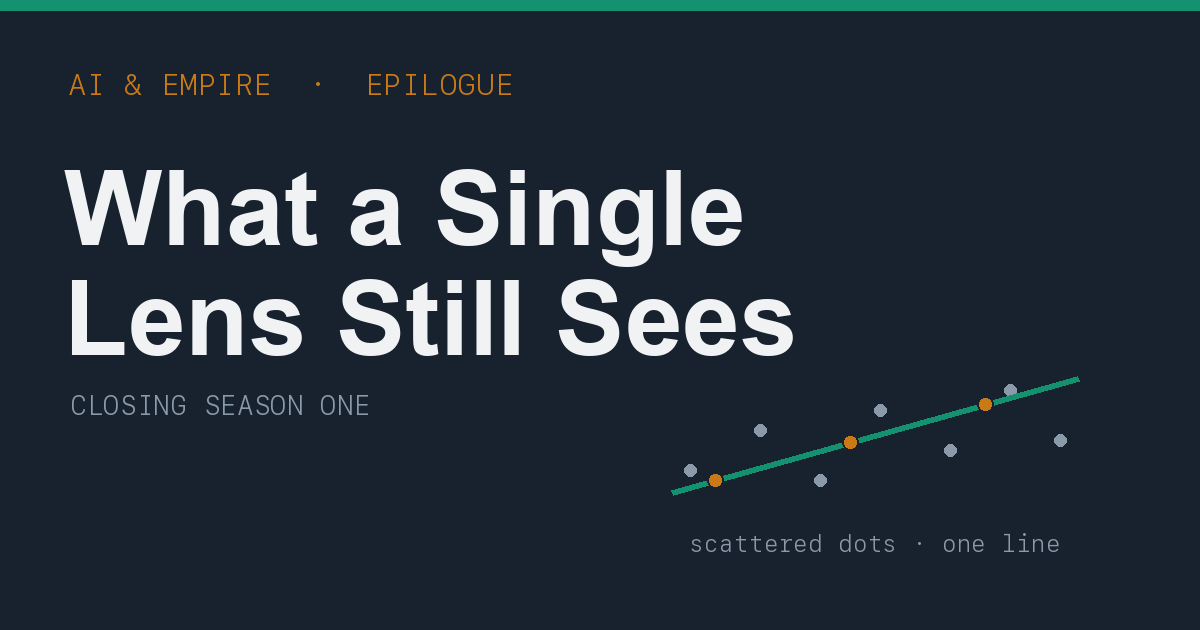
The first post in this series opened with a number: 40%. I want to close it with a confession instead. Across seven chapters, the thing I was really trying to test may not have been a claim about AI at all.
The dots were there long before the writing
Since last year, loose things had been accumulating in my head. Hunches from using AI every day. The layoffs and hiring wars cycling through the news. Countries maneuvering over semiconductors. And a war in Europe that would not end. Each was a separate article on a separate page, apparently unrelated to the others.
At some point they started reading like scenes from the same story — a productivity shift that begins at one desk, passes through the shape of organizations, reaches nations, and finally touches the grammar of conflict. That was an intuition with no way to check itself. Season 1 was my attempt to translate it into a form that could be checked.
What it’s like to write with AI
I wrote this series with AI, and I see no reason to hide it. Finding studies, checking numbers against their original sources, discarding claims that couldn’t be verified — work that would have taken me months alone took weeks. Trimming overstated sentences down to the size of their evidence was joint work too.
The interesting part came after. The more material piled up, the clearer it became which part of this series AI could not do for me. Which dot to connect to which. Where to stop, and where to climb one level higher. Why a story that begins with productivity had to end at war and norms. Every one of those choices came from the scattered dots that had been accumulating in me since last year.
Writing in the age of skill compression
The first chapter of this season opened with research showing AI lifts the floor faster than the ceiling. Apply that logic to writing and you get an uncomfortable conclusion. Drafting sentences, summarizing sources, building plausible structure — the very skills AI helped me with here — are being leveled. Someday AI will write a series like this on its own. That day may be closer than it looks.
Even so, I suspect one thing will resist leveling for a long time: the position from which you look at the world.
AI speaks from somewhere near the center of gravity of every perspective it absorbed. It is balanced — and therefore stands nowhere. A person’s lens is tilted by construction: shaped by where you’ve lived, what has failed you, what you do every day. I’ve come to think that tilt is not a defect but a point of view. Gathering facts is becoming a commodity; the angle that joins them into one story still comes from one person’s seat.
Collecting facts is being leveled. The place you see the world from is not.
The biggest thing I take from Season 1 isn’t traffic or a finished manuscript. It’s the experience of drawing one line through my own scattered assumptions and the reality outside — and knowing the line can now be tested. It may be wrong. But only someone who has drawn a line gets to find out where.
Next — where does the tilt come from?
Which opens the next question. If one person’s lens matters that much, where does it come from? A point of view doesn’t fall from the sky. It is raised — in families, in schools, inside the technologies of its time.
And technology has always reshaped the raising itself. Books did. Television did. Smartphones did. Now AI is stepping into that role — beside children, and, in a stranger direction, beside the people whose job is to raise AI itself.
That’s Season 2. How technology has kept changing how we raise people, what societies gained and lost each time, and how the same pattern is likely to repeat as we raise AI. If Season 1 asked how AI rewrites work and power, Season 2 asks who raises the lens that will live in that world.
Thank you for reading. The seven chapters of Season 1 all start from the map below.
Note. This is a personal essay — unlike the main chapters, it carries the author’s experience and opinions rather than research citations. Season 1 begins at the overview: AI Is Rewriting Work.
이 시리즈의 첫 글은 40%라는 숫자로 시작했다. 마지막 글은 숫자가 아니라 고백으로 시작하려 한다. 일곱 편을 쓰는 동안 내가 확인하고 싶었던 것은, 사실 AI에 대한 것이 아니었을지도 모른다.
점들은 오래전부터 있었다
작년부터 머릿속에 흩어져 있던 것들이 있다. AI를 매일 쓰면서 생긴 가정들. 뉴스에서 반복되는 감원과 영입 경쟁. 반도체를 둘러싼 나라들의 신경전. 그리고 유럽에서 계속되고 있는 전쟁. 각각은 다른 지면의 다른 기사였고, 서로 상관없는 이야기처럼 보였다.
그런데 어느 순간부터 그것들이 같은 이야기의 다른 장면처럼 읽히기 시작했다. 한 사람의 책상에서 시작한 생산성의 변화가 조직을 지나 국가에 닿고, 끝내 충돌의 문법을 건드린다는 — 확인할 길 없는 직감. 시즌 1은 그 직감을 검증 가능한 형태로 옮겨보려는 시도였다.
AI와 함께 쓴다는 것
이 시리즈는 AI와 함께 썼다. 숨길 생각은 없다. 연구를 찾고, 수치를 원 출처와 대조하고, 확인되지 않는 주장을 걸러내는 일에서 AI는 나 혼자서라면 몇 달 걸렸을 작업을 몇 주로 줄여줬다. 과장된 문장을 근거의 크기에 맞게 깎는 일도 함께했다.
그런데 흥미로운 건 그다음이었다. 자료가 쌓일수록 분명해진 것은, 이 시리즈에서 AI가 대신할 수 없었던 부분이 무엇인가였다. 어떤 점과 어떤 점을 이을지. 어디서 멈추고 어디서 한 층 더 올라갈지. 왜 하필 생산성 이야기의 끝이 전쟁과 규범이어야 하는지. 그 선택들은 전부, 작년부터 내 안에 쌓여 있던 흩어진 점들에서 나왔다.
스킬이 평준화되는 시대의 글쓰기
시즌 1의 첫 챕터는 AI가 바닥을 천장보다 빠르게 끌어올린다는 연구로 시작했다. 그 논리를 글쓰기에 적용하면 불편한 결론이 나온다. 문장을 만들고, 자료를 요약하고, 그럴듯한 구조를 짜는 능력 — 내가 이 시리즈에서 AI의 도움을 받은 바로 그 능력들 — 은 평준화되고 있다. 언젠가 AI가 이런 시리즈를 혼자서 쓸 수 있게 될 것이다. 그날은 생각보다 가까울지도 모른다.
그럼에도 하나는 쉽게 평준화되지 않으리라 생각한다. 세상을 어느 자리에서 바라볼 것인가다.
AI는 학습한 모든 관점의 무게중심 근처에서 말한다. 균형 잡혀 있고, 그래서 어디에도 서 있지 않다. 반면 사람의 시선은 태생적으로 치우쳐 있다 — 살아온 자리, 겪은 실패, 매일 하는 일이 만든 기울기. 나는 이 기울기가 결함이 아니라 관점이라고 생각한다. 흩어진 사실은 누구나 모을 수 있게 됐지만, 그것을 하나의 서사로 잇는 각도는 여전히 한 사람의 자리에서 나온다.
사실을 모으는 일은 평준화된다. 세상을 바라보는 자리는 평준화되지 않는다.
시즌 1을 쓰며 얻은 가장 큰 것은 조회수도 완성된 원고도 아니었다. 내 안의 흩어진 가정과 상상, 그리고 바깥에서 벌어지는 현실을 하나의 선으로 이어봤다는 경험 자체였다. 그 선이 틀렸을 수도 있다. 그러나 선을 그어본 사람만이 어디가 틀렸는지 확인할 수 있다.
다음 이야기 — 그 기울기는 어디서 오는가
여기서 다음 질문이 열린다. 한 사람의 시선이 그렇게 소중하다면, 그 시선은 어디서 오는가. 사람의 관점은 하늘에서 떨어지지 않는다. 길러진다 — 가정에서, 학교에서, 시대의 기술 속에서.
그리고 기술은 언제나 기르는 일 자체를 바꿔왔다. 책이, 텔레비전이, 스마트폰이 그랬다. 이제 AI가 그 자리에 들어오고 있다. 아이 곁에도, 그리고 — 더 낯선 방향으로 — AI 자신을 ‘기르는’ 사람들의 자리에도.
시즌 2는 그 이야기다. 기술이 양육을 어떻게 바꿔왔는지, 그 결과 사회가 무엇을 얻고 잃었는지, 그리고 같은 패턴이 AI를 기르는 일에서 어떻게 반복될지. 시즌 1이 ‘AI가 일과 권력을 어떻게 바꾸는가’였다면, 시즌 2는 ‘그 세계를 살아갈 시선은 누가 기르는가’다.
읽어주셔서 고맙다. 시즌 1의 일곱 챕터는 아래 지도에서 시작할 수 있다.
안내. 이 글은 개인 에세이로, 시리즈 본편과 달리 연구 인용이 아니라 저자의 경험과 생각을 담았다. 시즌 1 전체는 개요 글 — AI는 일을 다시 쓰고 있다 — 에서 시작할 수 있다.
The last chapter left a hard question. If getting stronger only resets the race — and pushes the conflict into new channels — is there any way out at all? History ran this experiment once. Its answer wasn’t “get stronger.” It was “get stronger and build the rules — at the same time.”
The Cold War’s forgotten half
Everyone remembers the warheads. Few remember what the same two superpowers built alongside them.
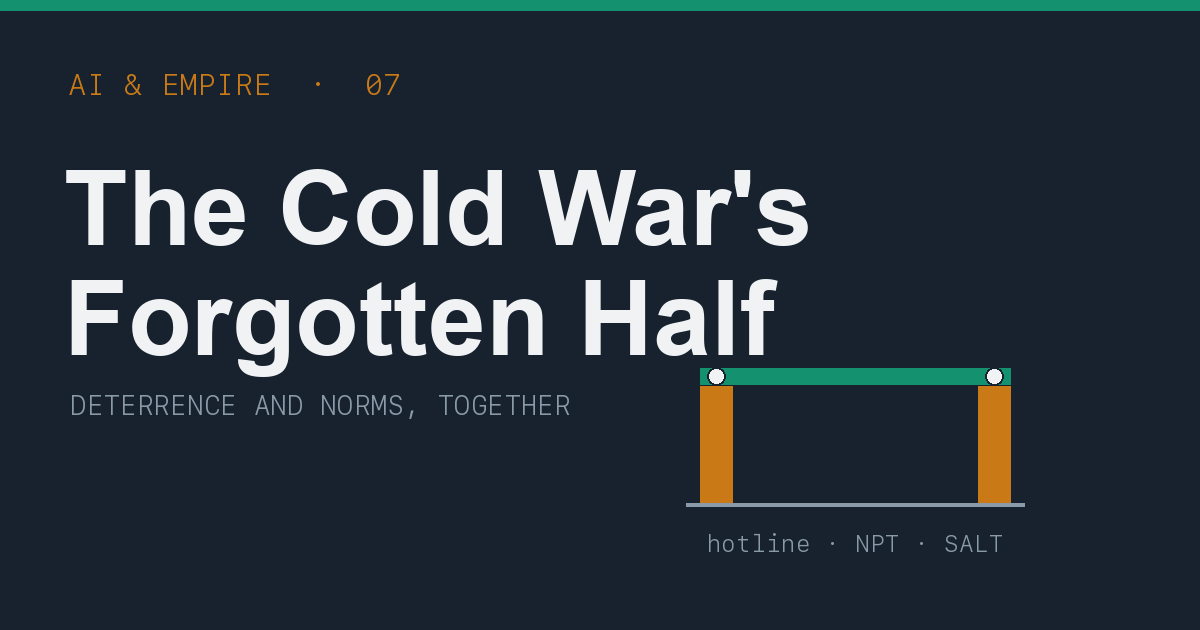
At the height of the nuclear standoff, the United States and the Soviet Union stacked weapons — and simultaneously opened the Moscow–Washington hotline (1963), signed the Nuclear Non-Proliferation Treaty (adopted 1968), and negotiated the first Strategic Arms Limitation Treaty, SALT I (1972). Deterrence and norms were built in the same years, by the same rivals.
The result wasn’t peace. It was something narrower and more valuable: the prevention of total nuclear war.
Strength and cooperation aren’t opposites
The usual framing treats “get strong” and “cooperate” as a choice — pick one. The Cold War shows they’re complements.
Deterrence without norms is a hair-trigger: capability with no channel to manage a crisis. Norms without deterrence is a wish: rules no one has reason to keep. Put together, they produce something neither can alone — strategic stability.
Strength and cooperation aren’t opposites. In the one experiment history has run, they only worked together.
The AI era needs the same two axes
Run it forward to AI, and the template holds.
The first axis is internal capability. Because AI is dual-use, a capability gap is a defensive vulnerability, not just a competitive one. Protecting talent, opening tool access across an organization, redesigning how work is done — these are the defense of technological sovereignty. (Which is why shedding talent carelessly, as an earlier chapter argued, is punching a hole in your own line.)
The second axis is conflict-management norms. International agreement on autonomous-weapons limits, data governance, and AI-safety standards is what keeps competition from tipping into catastrophe.
The window is closing
There’s a deadline built into this. Specialists call the present moment the “pre-proliferation window” — the last stretch before autonomous weapons diffuse beyond control, the way small arms did. Once they spread, norms are far harder to write. Analysts point to the Convention on Certain Conventional Weapons’ Seventh Review Conference, set for November 2026, as a practical deadline.
Which means the two axes can’t be built in sequence — strength now, rules later. They have to be built together, and soon.
Where the series lands
This is where a long line finally arrives. A single “40% faster” at one desk traveled up to the shape of a company, to how nations compete, to the grammar of conflict. And at the end, the resolution isn’t to win the race.
It’s to change what winning means: strength paired with the rules that keep strength from becoming catastrophe. The Cold War is the one time humanity held those two together long enough to survive its own capabilities. The AI era is asking whether we can do it again — faster.
Sources. Arms Control Association historical briefs; Thomas C. Schelling (1966), Arms and Influence, Yale University Press — the crisis-management mechanisms the US and USSR built after the Cuban Missile Crisis (1962): the Moscow–Washington hotline (1963), the Nuclear Non-Proliferation Treaty (adopted 1968, in force 1970), and SALT I (1972); Schelling’s account of deterrence and norms as complementary supports of strategic stability. On mutual assured destruction: Thomas C. Schelling (1960), The Strategy of Conflict. On the “pre-proliferation window”: Usanas Foundation (2026), Regulating Lethal Autonomous Weapons Systems in a Fractured Multipolar Order, which points to the CCW’s Seventh Review Conference (16–20 November 2026, Geneva) as a practical deadline.
지난 글은 어려운 질문 하나를 남겼다. 강해지는 것이 경쟁을 원점으로 되돌리고 갈등을 새 통로로 밀어 넣기만 한다면, 대체 빠져나갈 길은 있는가. 역사는 이 실험을 한 번 해봤다. 그 답은 ‘더 강해지는 것’이 아니었다. ‘강해지는 것, 그리고 규칙을 만드는 것 — 동시에’였다.
냉전의 잊힌 절반
모두가 핵탄두를 기억한다. 같은 두 초강대국이 그 옆에 무엇을 세웠는지는 거의 기억하지 못한다.
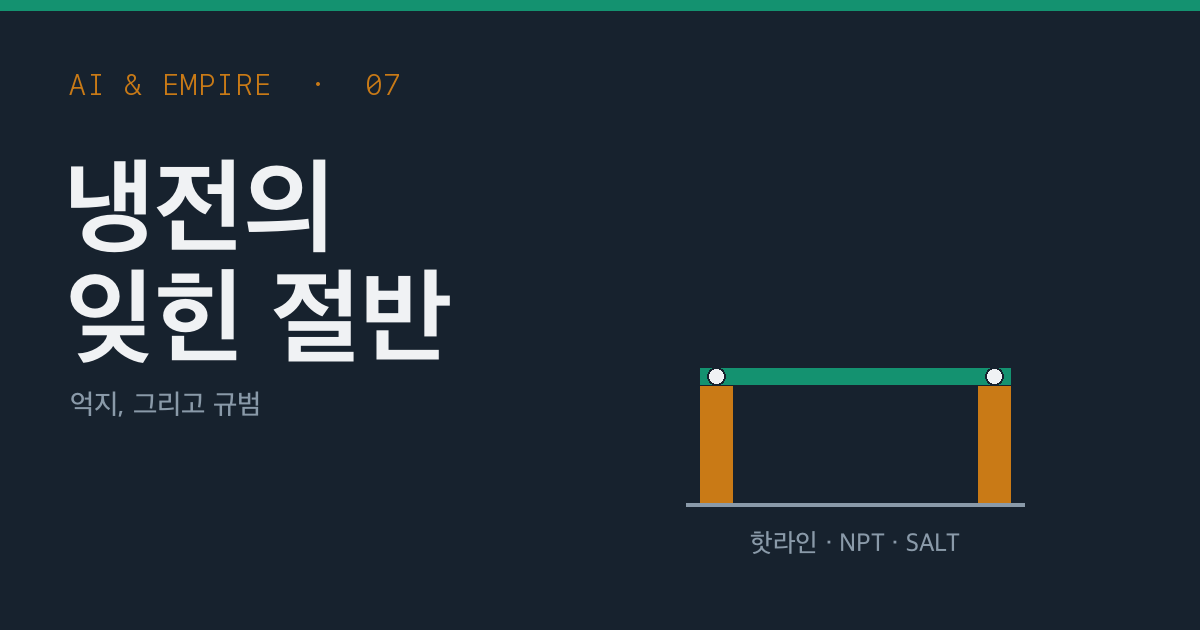
핵 대치가 정점이던 시기, 미국과 소련은 무기를 쌓으면서 — 동시에 모스크바-워싱턴 핫라인을 열었고(1963), 핵비확산조약(NPT)에 서명했으며(1968 채택), 첫 전략무기제한협정 SALT I를 협상했다(1972). 억지와 규범이 같은 시기에, 같은 경쟁자들 손으로 만들어졌다.
그 결과는 평화가 아니었다. 그보다 좁지만 더 값진 것 — 전면 핵전쟁의 방지였다.
강해지는 것과 협력하는 것은 대립하지 않는다
흔한 프레임은 ‘강해지기’와 ‘협력하기’를 양자택일로 놓는다. 냉전은 둘이 보완재임을 보여준다.
규범 없는 억지는 방아쇠에 손을 얹은 상태다 — 위기를 관리할 통로 없는 역량. 억지 없는 규범은 희망사항이다 — 아무도 지킬 이유가 없는 규칙. 둘을 합치면 어느 하나로도 못 만드는 것이 나온다 — 전략적 안정.
강해지는 것과 협력하는 것은 대립하지 않는다. 역사가 해본 단 한 번의 실험에서, 그 둘은 함께일 때만 작동했다.
AI 시대에 필요한 것도 이 두 축이다
AI로 옮겨도 이 틀은 성립한다.
첫째 축은 내부 역량이다. AI가 이중 사용 기술인 한, 역량의 공백은 경쟁만이 아니라 방어의 취약점이 된다. 인재를 지키고, 조직 전반에 도구 접근을 열고, 일하는 방식을 재설계하는 것 — 이것이 기술 주권의 방어다. (앞선 글에서 짚었듯, 인재를 무분별하게 내보내는 것은 스스로 방어선에 구멍을 내는 일이다.)
둘째 축은 갈등 관리 규범이다. 자율무기 규제, 데이터 거버넌스, AI 안전 표준에 관한 국제 합의가 경쟁이 파국으로 넘어가지 않게 붙든다.
창은 닫히고 있다
여기엔 마감이 걸려 있다. 전문가들은 지금을 ‘확산 이전 창(pre-proliferation window)’이라 부른다 — 자율무기가 소형화기처럼 통제 불가능하게 퍼지기 전, 마지막 구간이다. 일단 퍼지면 규범을 쓰기가 훨씬 어려워진다. 분석가들은 2026년 11월로 예정된 특정재래식무기금지협약(CCW) 7차 검토회의를 실질적 마감으로 지목한다.
그렇다면 두 축은 순차로 세울 수 없다 — 지금은 힘, 규칙은 나중에, 가 아니다. 함께, 그리고 빨리 세워야 한다.
시리즈가 도착하는 자리
여기서 긴 선 하나가 마침내 도착한다. 한 책상의 ‘40% 더 빠르게’가 회사의 모양으로, 국가의 경쟁으로, 충돌의 문법으로 번져 올라갔다. 그리고 끝에서, 해답은 경쟁에서 이기는 것이 아니다.
그것은 이기는 것의 의미를 바꾸는 것이다 — 힘을, 그 힘이 파국이 되지 않게 붙드는 규칙과 짝지우는 것. 냉전은 인류가 자신의 역량에서 살아남을 만큼 그 둘을 함께 쥐었던 단 한 번의 시간이다. AI 시대는 우리가 그것을 다시 해낼 수 있는지 — 더 빠르게 — 묻고 있다.
근거. Arms Control Association 역사 브리프; Thomas C. Schelling (1966), Arms and Influence, Yale University Press — 쿠바 미사일 위기(1962) 직후 미·소가 구축한 세 위기관리 장치: 모스크바-워싱턴 핫라인(1963), 핵비확산조약(1968 채택·1970 발효), SALT I(1972). 억지와 규범이 전략적 안정의 상호 보완 축이라는 셸링의 논거. 상호확증파괴(MAD)에 관하여: Thomas C. Schelling (1960), The Strategy of Conflict. ‘확산 이전 창’에 관하여: Usanas Foundation (2026), Regulating Lethal Autonomous Weapons Systems in a Fractured Multipolar Order — CCW 7차 검토회의(2026년 11월 16–20일, 제네바)를 실질적 마감으로 지목.