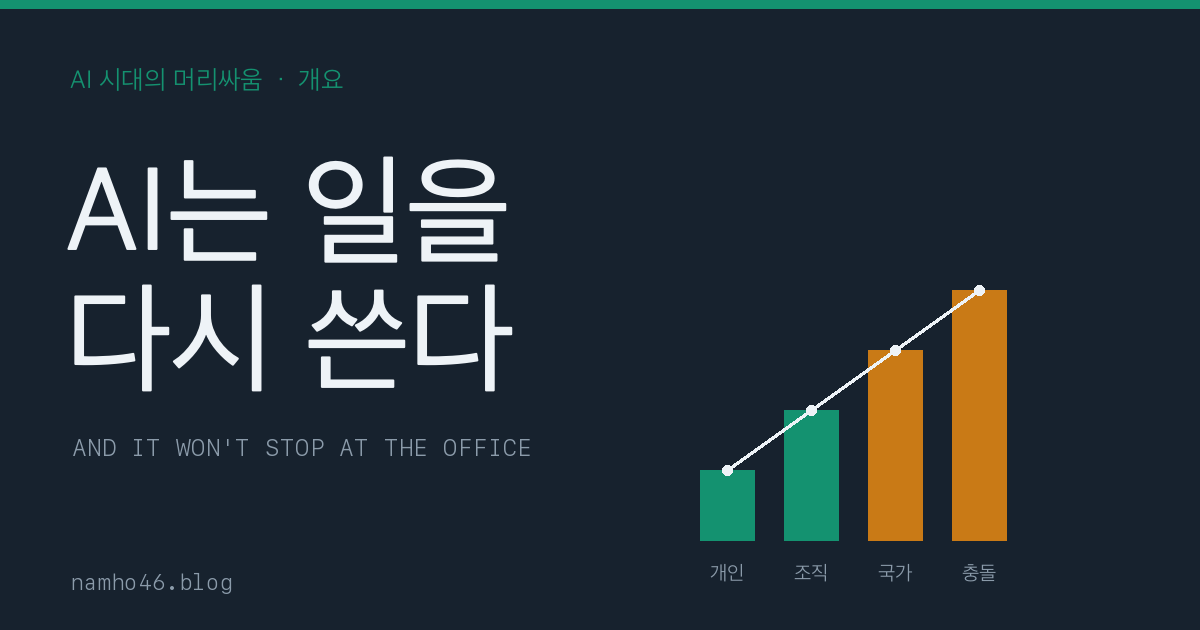
AI에 관한 대부분의 글은 생산성 수치에서 멈춘다. AI가 이 작업을 40% 빠르게 만들었다. 보통 이야기는 거기서 끝난다. 나는 흥미로운 부분이 바로 거기서 시작한다고 생각한다.
생산성의 향상은 결코 한자리에 머물지 않기 때문이다. 그것은 움직인다. 한 사람의 책상에서 회사의 모양으로, 다시 국가가 경쟁하는 방식으로, 그리고 — 역사가 말해준다면 — 충돌의 문법으로까지 번져 올라간다. 이 페이지는 그 여정의 지도다. 아래 각 정거장은 짧은 요약이고, “→” 링크가 연구에 근거한 각 챕터의 전문을 연다.
두 노동자 사이의 격차에서 시작한다
AI가 처음 바꾸는 것은 산출물이 아니다. 누가 그것을 만드는가다.
2023년 MIT 실험에서 AI를 쓴 전문직은 작업 시간을 40% 줄이고 품질을 18% 높였다. 그러나 놀라운 발견은 분포 속에 숨어 있었다 — 하위 성과자들의 향상폭이 가장 컸다. Fortune 500 콜센터 연구도 같은 결과를 냈다. 전체 평균 14% 향상, 그러나 하위 숙련군은 34%. 연구진은 이를 스킬 압축이라 불렀다. AI는 천장보다 바닥을 더 빠르게 끌어올린다.
30년간 경험은 성과의 가장 강력한 예측 변수였다. 스킬 압축은 그 공식에 균열을 낸다 — 그리고 조직이 사람을 채용하고, 붙잡고, 내보낼 때 무엇을 사고파는지를 조용히 바꾼다.
바닥이 올라가면, 다음 질문이 모든 경영 회의에 등장한다. 더 적은 인원으로 같은 성과를 낼 수 있는 것 아닌가?
여기서 생산성 이야기는 인재 이야기로 바뀐다. 한 사람이 떠날 때 함께 나가는 가치 — 암묵지, 고객을 읽는 감각, 실패에서 걸러낸 직관 — 는 AI 시대에 오히려 더 이동 가능해진다. 그 일부가 이제 프롬프트와 워크플로에 남아 사람과 함께 움직이기 때문이다. 효율을 얻으려 인재를 내보내는 것은 그 효율을 조용히 경쟁사에 넘기는 일이 될 수 있다.
AI 경쟁을 결정하는 자원 — 고품질 데이터, 첨단 반도체, 프런티어 인재 — 은 인터넷과 다르다. 인터넷은 모두가 쓸수록 가치가 커지지만, 이 자원들은 제로섬에 가깝다. 한쪽이 확보하면 다른 쪽은 그만큼 잃는다. 그 지점에서 한 기업의 AI 역량은 한 국가의 역량으로 읽히고, “인재를 지키는 일”은 기술 주권의 문제가 된다.
여기서 생산성 이야기는 예상 밖의 곳에 도착한다 — 그리고 이것이 대부분의 보도가 놓치는 줄기다.
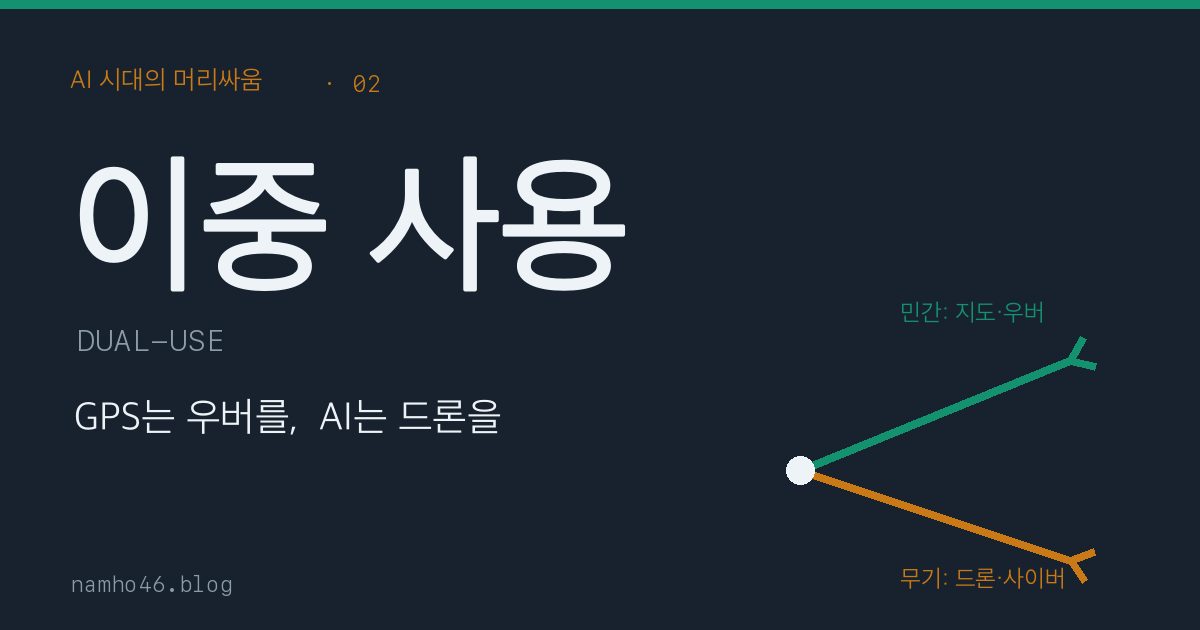
전기와 인터넷은 소유자를 자동으로 무장시키지 않으며 퍼졌다. AI는 한 가지 결정적인 점에서 다르다. 이중 사용(dual-use)이다. 민간 도구가 수십 년이 아니라 수개월 만에 군사용으로 전환된다. RAND는 그 경로를 기록한다 — 컴퓨터 비전 AI가 타격 드론 제어로, 고객 서비스 언어 모델이 허위정보 도구로. 그리고 이것은 이론이 아니다. 우크라이나에서, 상업용 부품과 오픈소스로 만든 드론이 전선 사상자의 약 70~80%와 얽혀 있다.
냉전은 대부분이 잊은 본보기를 남겼다. 초강대국들은 핵탄두를 쌓으면서 동시에 핫라인, 핵비확산조약, 군축 협상을 만들었다. 억지와 규범이 함께 작동했다. AI 시대에도 두 축이 필요하다 — 내부 역량 그리고 경쟁을 관리 가능하게 유지하는 규범. 이 시리즈가 향해 가는 논지다.
나는 한국에 사는 개발자이고 매일 AI를 쓴다. 그렇게 매일 쓰다 보니 떨쳐지지 않는 질문이 생겼다 — 이건 대체 어디로 가고 있을까? 이 블로그는 그 질문에 조심스럽게 답해보려는 시도다 — 연구를 읽고, 하나의 논문에서 시작한 선을 조직과 국가까지 따라가며, 짧은 챕터로 하나씩 적어 나간다.
위 지도가 흥미롭다면 링크를 따라 각 챕터로 들어가거나, 소개 페이지부터 시작해도 좋다. 새 챕터는 일정한 간격으로 올라오고, 이 페이지도 그와 함께 자라난다.
New chapters land on a regular cadence. Subscribe to get each one by email.
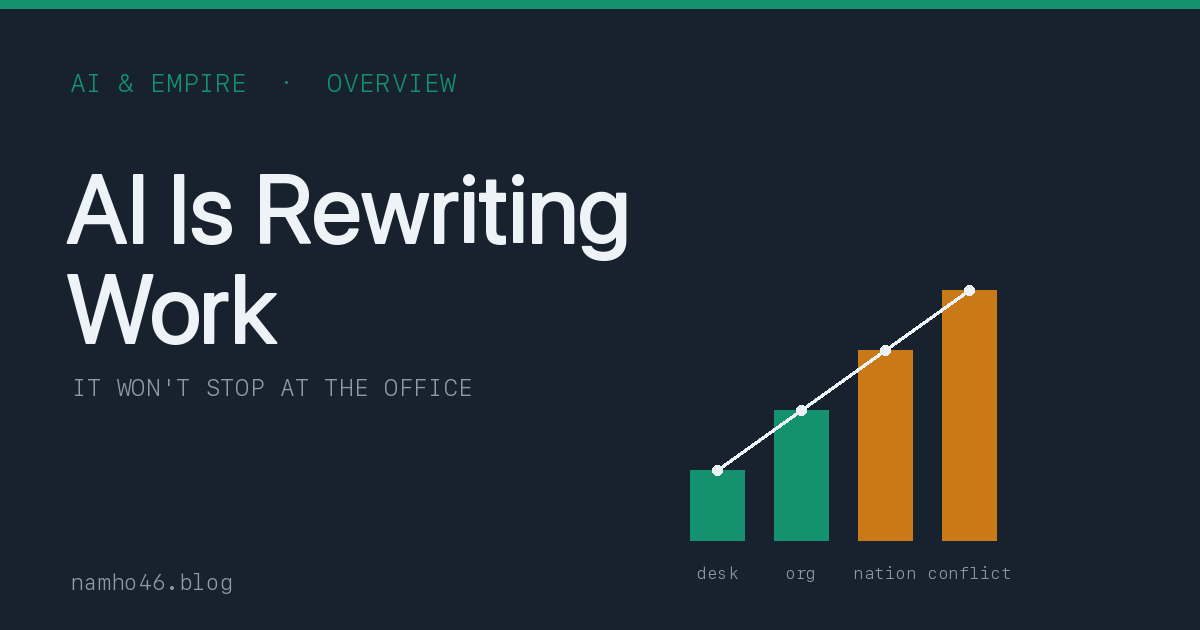
Most writing about AI stops at the productivity number: AI made this task 40% faster. That’s where the story usually ends. I think it’s where the interesting part begins.
Because a productivity gain never stays put. It moves. It travels up from a single person’s desk to the shape of a company, then to how nations compete, and — if history is any guide — to the grammar of conflict itself. This page is the map of that journey. Each stop below is a short summary; the “→” links open the full chapter, each one grounded in the research.
It starts with a gap between two workers
The first thing AI changes isn’t output. It’s who produces it.
In a 2023 MIT experiment, professionals using AI cut task time by 40% and raised quality by 18%. But the striking finding was hidden in the distribution: the lowest performers improved the most. A Fortune 500 call-center study found the same — a 14% average gain, but 34% for the least-skilled group. Researchers named it skill compression: AI raises the floor faster than the ceiling.
For thirty years, experience was the strongest predictor of performance. Skill compression cracks that formula — and quietly changes what an organization is buying when it hires, keeps, or lets go of people.
Once the floor rises, the next question lands in every management meeting: can we do the same with fewer people?
That’s where the productivity story turns into a talent story. The value that walks out the door when someone leaves — the tacit knowledge, the read on a customer, the instinct filtered from past failure — gets more portable in the AI era, not less, because some of it now lives in prompts and workflows a person can take with them. Cutting talent to bank an efficiency gain can quietly hand that gain to a competitor.
Scale the same logic up one more level and it stops being about companies.
The resources that decide the AI race — high-quality data, advanced chips, frontier talent — are not like the internet, where everyone using it makes it more valuable. They’re closer to zero-sum: what one side secures, another is denied. At that point a company’s AI capacity reads as a country’s capacity, and “keeping your talent” becomes a question of technological sovereignty.
Here the productivity story arrives somewhere unexpected — and this is the throughline most coverage misses.
Electricity and the internet spread without automatically arming their owners. AI is different in one decisive way: it is dual-use. A civilian tool converts to a military one in months, not decades. RAND documents the paths — computer-vision AI to strike-drone control, a customer-service language model to disinformation tooling. And it isn’t theoretical: in Ukraine, drones built from commercial parts and open-source software are tied to roughly 70–80% of frontline casualties.
The line between a productivity tool and a weapon is being erased — not in theory, but already in reality.
If every actor simply hoards talent and capability, you get another round of leveling — and, by the logic above, another basis for conflict. So strength alone isn’t the answer.
The Cold War offers the template most people forget: the superpowers stacked warheads and built hotlines, non-proliferation treaties, and arms-control talks at the same time. Deterrence and norms worked together. The AI era needs both axes too — internal capability and the norms to keep competition manageable. That’s the argument the series builds toward.
I’m a developer in Korea who uses AI every day, and that daily use left me with a question I couldn’t shake: where is this all heading? This blog is me trying to answer it carefully — reading the research, following the line from one study out to organizations and nations, and publishing it one short chapter at a time.
If the map above is interesting, follow the links into the chapters, or start with the about page. New chapters land on a regular cadence — and this page will grow as they do.
History answers with two faces. And which face is right decides what we should actually watch for in the age of AI.
Leveling doesn’t cause war
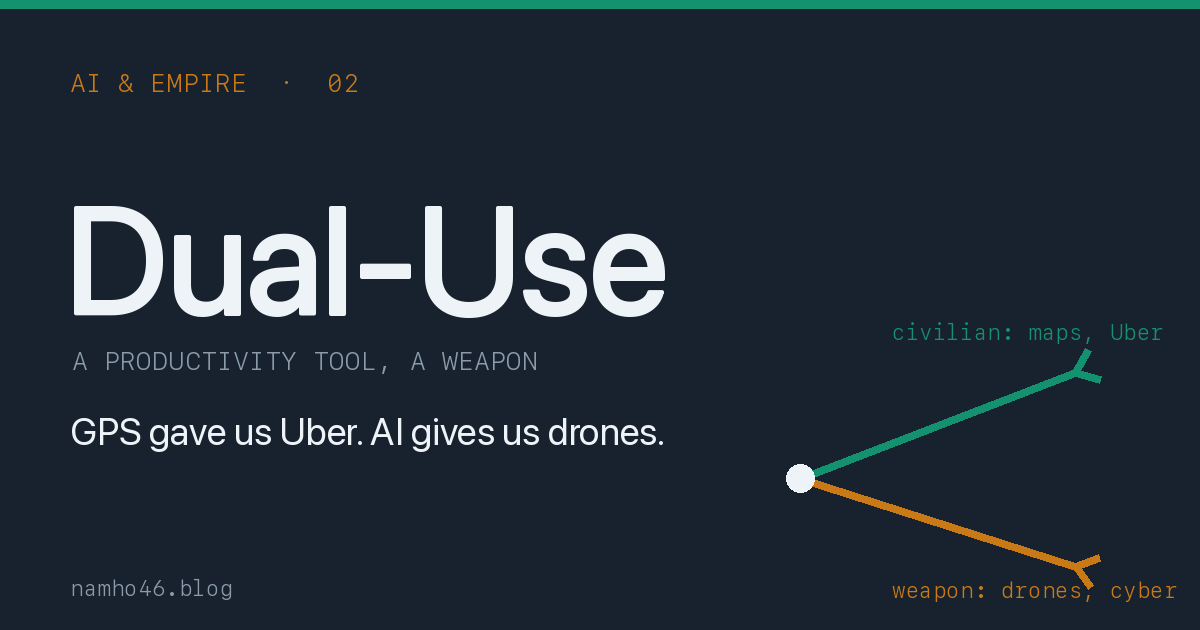
When the U.S. opened GPS to civilians, the world built Uber and Google Maps — not war.
The internet made people collaborate across borders. Electrified nations did not invade the un-electrified.
So let’s be clear. The determinism that says leveling technology equals conflict is wrong. This piece does not make that claim.
I only want to ask the question more precisely. Is AI the same kind of technology as electricity or the internet?
The one decisive difference: dual-use
To turn electricity into a weapon, you need a separate, complex system. AI doesn’t work that way.
RAND maps how AI built as a civilian tool crosses over into military use:
Computer-vision AI for self-driving and logistics → the control system of a strike drone
A language model for customer service → a tool for spear-phishing and disinformation
Medical-diagnostic AI → military intelligence analysis and target identification
Each conversion is reported to take months to under a year.
Electricity, the internet, and GPS were largely “single-use” — hard to weaponize directly. AI does not share that property.
This is not theory
If that sounds abstract, look at Ukraine.
A war is being fought in Ukraine in which drones made from commercial parts and open-source software were tied to roughly 70–80% of frontline casualties as of 2024.
DJI sensors, commercial flight controllers, open software like ArduPilot. That list doubles as the parts manifest of a consumer drone.
The line between productivity tech and weapons tech is being erased — not in theory, but already in reality.
So what changes?
Leveling technology does not automatically cause war. That still holds.
But when a technology that can become a weapon at any time levels out, the arithmetic shifts. The moment a rival’s civilian AI capacity reads as latent military capacity, the margin for trust narrows.
This piece is not written to make you fear AI.
But optimism built on the assumption that AI is “the same kind” as electricity or the internet has to be re-examined against this one difference.
The next piece turns to the second difference — the zero-sum resources that make me weaker the more I share.
Sources. RAND Corporation (2025, Sep), The Artificial General Intelligence Race and International Security — classifies AI as dual-use; civilian-to-military conversion cases and timelines (months to a year). · US Army War College War Room (2025, Aug), AI’s Growing Role in Modern Warfare — ~70–80% of 2024 frontline casualties drone-related, built from commercial parts and open-source software.
근거. RAND Corporation (2025, 9월), The Artificial General Intelligence Race and International Security — AI를 이중 사용 기술로 분류, 민간→군사 전환 사례와 소요 시간(수개월~1년). · US Army War College War Room (2025, 8월), AI’s Growing Role in Modern Warfare — 2024년 기준 전선 사망자 약 70~80%가 드론 관련, 상용 부품·오픈소스 소프트웨어로 구성.
They are quietly shaking how organizations have managed talent for three decades. Here’s the takeaway up front: AI raises the floor of skill more than it raises the ceiling.
The story is behind the 40%
In 2023, 453 professionals joined an online experiment run by MIT researchers. Half could use an AI tool; half worked alone.
The AI group cut their task time by 40% and raised quality by 18%. So far, unsurprising.
What actually surprised the researchers was not the average. The lowest performers improved far more than the top ones did. They named it: skill compression.
The same thing in a call center
That same year, an AI assistant reached the customer support center of a Fortune 500 company. Overall productivity rose 14% — an ordinary-looking figure.
Look inside, though. The least-skilled group improved 34%. A two-month-new hire, tool in hand, resolved issues about as fast as a mid-career colleague working without one.
Both studies point the same way. AI lifts the floor — and it lifts it more than the ceiling.
Why this shakes organizations
For decades, experience was the strongest predictor of performance. That a ten-year veteran beats a three-year junior felt like a law of nature. Experience was scarce, so it was expensive.
AI cracked that formula. It captures the patterns and judgment experience builds — imperfectly, but remarkably closely.
So the less experienced, working with AI, catch up fast. The clearest case: junior developers using AI coding tools narrowed the commit gap with seniors.
The wall built by experience is getting lower. The baseline itself is moving up.
So, should you cut headcount?
Here many executives ask themselves: “Can’t we get the same output with fewer people?”
But skill compression may say the opposite. The floor-raising effect appears only when everyone holds the same tool.
An organization where only a few top performers use AI just preserves the old gap. One where everyone uses it lifts the whole baseline — and that lead gets harder to catch over time.
Change the question. Not “whom do we cut?” but “how do we lift everyone?”
The next piece turns to the opposite move — letting talent go — and why it costs far more than it looks.
Sources. Noy & Zhang (2023), Experimental Evidence on the Productivity Effects of Generative AI, MIT Working Paper — RCT with 453 professionals; 40% less time, 18% higher quality, largest gains among lower performers. · Brynjolfsson, Li & Raymond (2025), Generative AI at Work, NBER WP 31161 — customer support: +14% overall, +34% for the least-skilled group.
근거. Noy & Zhang (2023), Experimental Evidence on the Productivity Effects of Generative AI, MIT Working Paper — 전문직 453명 무작위 대조 실험. 시간 40%↓·품질 18%↑, 하위군의 향상폭이 가장 큼. · Brynjolfsson, Li & Raymond (2025), Generative AI at Work, NBER WP 31161 — 고객지원 센터 전체 14%·하위 숙련군 34% 향상.