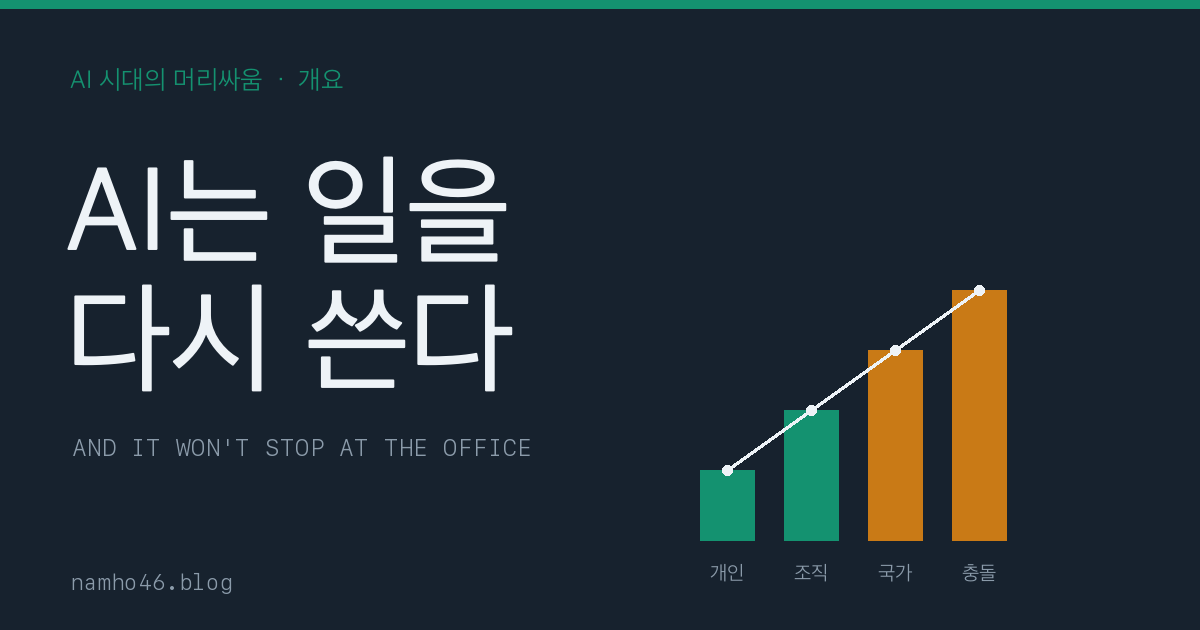
AI에 관한 대부분의 글은 생산성 수치에서 멈춘다. AI가 이 작업을 40% 빠르게 만들었다. 보통 이야기는 거기서 끝난다. 나는 흥미로운 부분이 바로 거기서 시작한다고 생각한다.
생산성의 향상은 결코 한자리에 머물지 않기 때문이다. 그것은 움직인다. 한 사람의 책상에서 회사의 모양으로, 다시 국가가 경쟁하는 방식으로, 그리고 — 역사가 말해준다면 — 충돌의 문법으로까지 번져 올라간다. 이 페이지는 그 여정의 지도다. 아래 각 정거장은 짧은 요약이고, “→” 링크가 연구에 근거한 각 챕터의 전문을 연다.
두 노동자 사이의 격차에서 시작한다
AI가 처음 바꾸는 것은 산출물이 아니다. 누가 그것을 만드는가다.
2023년 MIT 실험에서 AI를 쓴 전문직은 작업 시간을 40% 줄이고 품질을 18% 높였다. 그러나 놀라운 발견은 분포 속에 숨어 있었다 — 하위 성과자들의 향상폭이 가장 컸다. Fortune 500 콜센터 연구도 같은 결과를 냈다. 전체 평균 14% 향상, 그러나 하위 숙련군은 34%. 연구진은 이를 스킬 압축이라 불렀다. AI는 천장보다 바닥을 더 빠르게 끌어올린다.
30년간 경험은 성과의 가장 강력한 예측 변수였다. 스킬 압축은 그 공식에 균열을 낸다 — 그리고 조직이 사람을 채용하고, 붙잡고, 내보낼 때 무엇을 사고파는지를 조용히 바꾼다.
바닥이 올라가면, 다음 질문이 모든 경영 회의에 등장한다. 더 적은 인원으로 같은 성과를 낼 수 있는 것 아닌가?
여기서 생산성 이야기는 인재 이야기로 바뀐다. 한 사람이 떠날 때 함께 나가는 가치 — 암묵지, 고객을 읽는 감각, 실패에서 걸러낸 직관 — 는 AI 시대에 오히려 더 이동 가능해진다. 그 일부가 이제 프롬프트와 워크플로에 남아 사람과 함께 움직이기 때문이다. 효율을 얻으려 인재를 내보내는 것은 그 효율을 조용히 경쟁사에 넘기는 일이 될 수 있다.
AI 경쟁을 결정하는 자원 — 고품질 데이터, 첨단 반도체, 프런티어 인재 — 은 인터넷과 다르다. 인터넷은 모두가 쓸수록 가치가 커지지만, 이 자원들은 제로섬에 가깝다. 한쪽이 확보하면 다른 쪽은 그만큼 잃는다. 그 지점에서 한 기업의 AI 역량은 한 국가의 역량으로 읽히고, “인재를 지키는 일”은 기술 주권의 문제가 된다.
여기서 생산성 이야기는 예상 밖의 곳에 도착한다 — 그리고 이것이 대부분의 보도가 놓치는 줄기다.
전기와 인터넷은 소유자를 자동으로 무장시키지 않으며 퍼졌다. AI는 한 가지 결정적인 점에서 다르다. 이중 사용(dual-use)이다. 민간 도구가 수십 년이 아니라 수개월 만에 군사용으로 전환된다. RAND는 그 경로를 기록한다 — 컴퓨터 비전 AI가 타격 드론 제어로, 고객 서비스 언어 모델이 허위정보 도구로. 그리고 이것은 이론이 아니다. 우크라이나에서, 상업용 부품과 오픈소스로 만든 드론이 전선 사상자의 약 70~80%와 얽혀 있다.
냉전은 대부분이 잊은 본보기를 남겼다. 초강대국들은 핵탄두를 쌓으면서 동시에 핫라인, 핵비확산조약, 군축 협상을 만들었다. 억지와 규범이 함께 작동했다. AI 시대에도 두 축이 필요하다 — 내부 역량 그리고 경쟁을 관리 가능하게 유지하는 규범. 이 시리즈가 향해 가는 논지다.
나는 한국에 사는 개발자이고 매일 AI를 쓴다. 그렇게 매일 쓰다 보니 떨쳐지지 않는 질문이 생겼다 — 이건 대체 어디로 가고 있을까? 이 블로그는 그 질문에 조심스럽게 답해보려는 시도다 — 연구를 읽고, 하나의 논문에서 시작한 선을 조직과 국가까지 따라가며, 짧은 챕터로 하나씩 적어 나간다.
위 지도가 흥미롭다면 링크를 따라 각 챕터로 들어가거나, 소개 페이지부터 시작해도 좋다. 새 챕터는 일정한 간격으로 올라오고, 이 페이지도 그와 함께 자라난다.
New chapters land on a regular cadence. Subscribe to get each one by email.
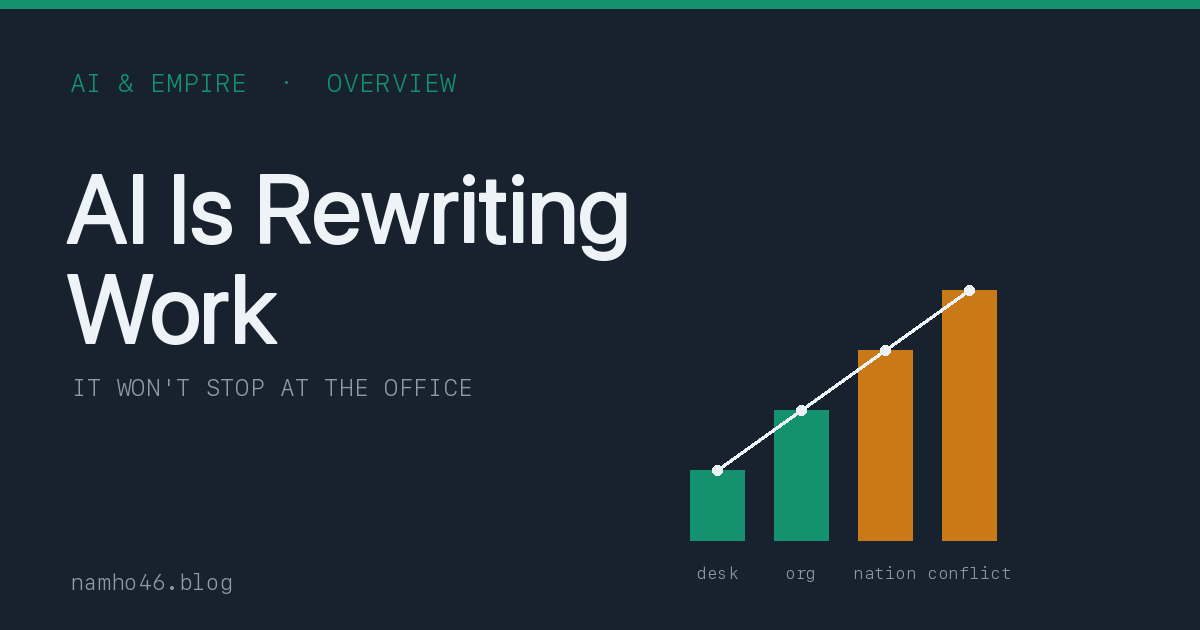
Most writing about AI stops at the productivity number: AI made this task 40% faster. That’s where the story usually ends. I think it’s where the interesting part begins.
Because a productivity gain never stays put. It moves. It travels up from a single person’s desk to the shape of a company, then to how nations compete, and — if history is any guide — to the grammar of conflict itself. This page is the map of that journey. Each stop below is a short summary; the “→” links open the full chapter, each one grounded in the research.
It starts with a gap between two workers
The first thing AI changes isn’t output. It’s who produces it.
In a 2023 MIT experiment, professionals using AI cut task time by 40% and raised quality by 18%. But the striking finding was hidden in the distribution: the lowest performers improved the most. A Fortune 500 call-center study found the same — a 14% average gain, but 34% for the least-skilled group. Researchers named it skill compression: AI raises the floor faster than the ceiling.
For thirty years, experience was the strongest predictor of performance. Skill compression cracks that formula — and quietly changes what an organization is buying when it hires, keeps, or lets go of people.
Once the floor rises, the next question lands in every management meeting: can we do the same with fewer people?
That’s where the productivity story turns into a talent story. The value that walks out the door when someone leaves — the tacit knowledge, the read on a customer, the instinct filtered from past failure — gets more portable in the AI era, not less, because some of it now lives in prompts and workflows a person can take with them. Cutting talent to bank an efficiency gain can quietly hand that gain to a competitor.
Scale the same logic up one more level and it stops being about companies.
The resources that decide the AI race — high-quality data, advanced chips, frontier talent — are not like the internet, where everyone using it makes it more valuable. They’re closer to zero-sum: what one side secures, another is denied. At that point a company’s AI capacity reads as a country’s capacity, and “keeping your talent” becomes a question of technological sovereignty.
Here the productivity story arrives somewhere unexpected — and this is the throughline most coverage misses.
Electricity and the internet spread without automatically arming their owners. AI is different in one decisive way: it is dual-use. A civilian tool converts to a military one in months, not decades. RAND documents the paths — computer-vision AI to strike-drone control, a customer-service language model to disinformation tooling. And it isn’t theoretical: in Ukraine, drones built from commercial parts and open-source software are tied to roughly 70–80% of frontline casualties.
The line between a productivity tool and a weapon is being erased — not in theory, but already in reality.
If every actor simply hoards talent and capability, you get another round of leveling — and, by the logic above, another basis for conflict. So strength alone isn’t the answer.
The Cold War offers the template most people forget: the superpowers stacked warheads and built hotlines, non-proliferation treaties, and arms-control talks at the same time. Deterrence and norms worked together. The AI era needs both axes too — internal capability and the norms to keep competition manageable. That’s the argument the series builds toward.
I’m a developer in Korea who uses AI every day, and that daily use left me with a question I couldn’t shake: where is this all heading? This blog is me trying to answer it carefully — reading the research, following the line from one study out to organizations and nations, and publishing it one short chapter at a time.
If the map above is interesting, follow the links into the chapters, or start with the about page. New chapters land on a regular cadence — and this page will grow as they do.
For more than forty years, two superpowers pointed enough warheads at each other to end civilization. They never fired one. Not once did an American and a Soviet army meet in open battle. And yet the era was not peaceful — it was one of the bloodiest stretches of the century. To see the war, you had to look away from Washington and Moscow: toward Korea, Vietnam, Angola, Afghanistan.
Balance stopped one war and started others
The Cold War is usually told as a success story of deterrence — mutual assured destruction kept the peace. Half of that is true. Thomas Schelling’s insight, that when both sides are equally vulnerable neither can afford to strike first, did help prevent a direct war between the United States and the Soviet Union. Between 1945 and 1991, the two never fought each other directly. Zero times.
But the conflict didn’t disappear. It moved. Korea (1950–53), Vietnam (1955–75), Angola (1975–76), Afghanistan (1979–89) — dozens of proxy wars where the superpowers fought through others. The energy that couldn’t discharge at the center found the weakest links at the edges.
Leveling doesn’t end war — it changes its shape
This is the lesson most easily missed: technological balance doesn’t remove conflict. It relocates and reshapes it.
When one side holds a decisive advantage, the competition has a ceiling — the weaker side can’t risk much. When the sides level, every move reads as a threat, and the conflict leaks into whatever channels stay open. Under the nuclear standoff, those channels were proxy wars.
Technological balance doesn’t end war. It changes the form the war takes.
The AI parallel: conflict in a lower key
Run the same logic forward. If every serious actor secures its AI capability — protects its talent, builds its compute, guards its data — the result is another kind of balance. And by the pattern above, balance doesn’t resolve competition; it pushes it into new channels.
We can already name them. Instead of open war, cyber operations. Instead of invasion, talent poaching and brain drain. Instead of a declaration, semiconductor export controls. These aren’t preludes to conflict — increasingly, they are the conflict, conducted in a lower key.
Why this matters now
If “just get stronger” were the answer, the Cold War would have ended in 1949, not 1991 — and without the proxy bloodshed. Strength alone didn’t buy peace; it bought a stable standoff that displaced the violence elsewhere.
That’s the uncomfortable conclusion this series keeps arriving at: in a leveling race, being strong is necessary but not sufficient. The next chapter takes up the other half — how the same Cold War that stacked warheads also built the hotlines and treaties that kept the standoff from tipping over.
Sources. Thomas C. Schelling (1960), The Strategy of Conflict, Harvard University Press — the foundational account of mutual assured destruction (MAD): mutual vulnerability paradoxically deters all-out war. Proxy-war record: between 1945 and 1991 the US and USSR had zero direct military clashes, while both intervened in dozens of proxy wars — Korea (1950–53), Vietnam (1955–75), Angola (1975–76), Afghanistan (1979–89) among them (Cold War proxy-conflict synthesis, Numberanalytics 2025).
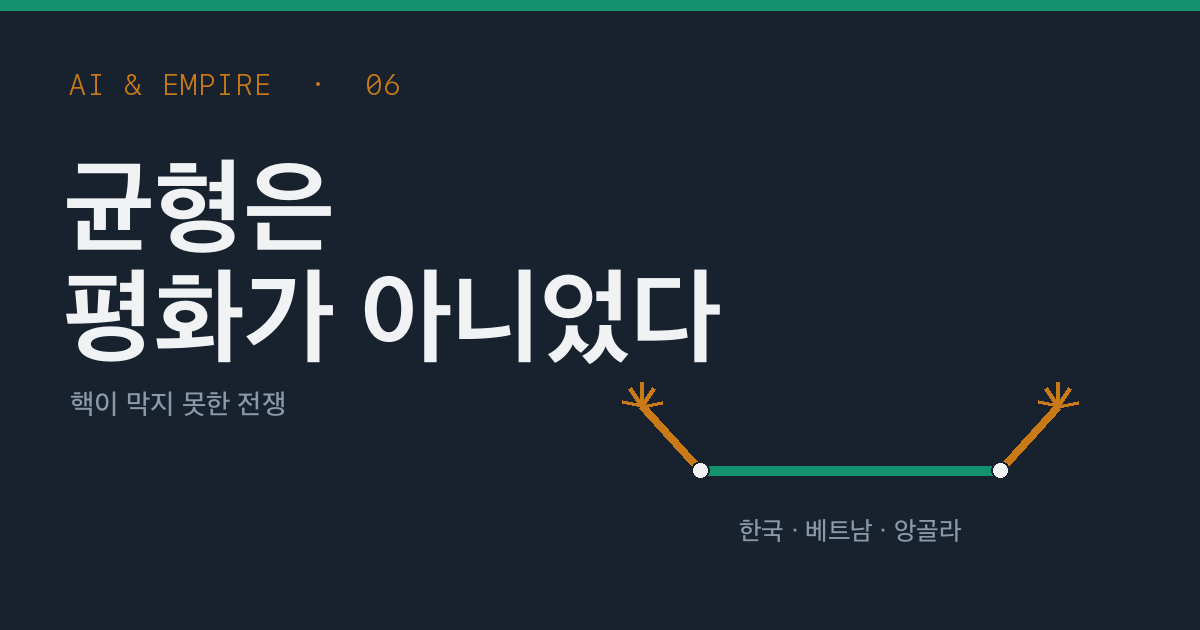
40년이 넘도록, 두 초강대국은 문명을 끝장낼 만큼의 핵탄두를 서로에게 겨눴다. 그리고 단 한 발도 쏘지 않았다. 미군과 소련군이 정면으로 맞붙은 적은 한 번도 없다. 그런데도 그 시대는 평화롭지 않았다 — 20세기에서 가장 많은 피가 흐른 시기 중 하나였다. 전쟁을 보려면 워싱턴과 모스크바에서 눈을 돌려, 한국과 베트남과 앙골라와 아프가니스탄을 봐야 했다.
균형은 한 전쟁을 막고 다른 전쟁을 열었다
냉전은 보통 억지의 성공담으로 이야기된다. 상호확증파괴(MAD)가 평화를 지켰다고. 절반은 맞다. 토머스 셸링의 통찰 — 양쪽이 똑같이 취약하면 누구도 먼저 칠 수 없다 — 는 실제로 미·소 전면전을 막는 데 기여했다. 1945년부터 1991년까지, 둘은 한 번도 직접 싸우지 않았다. 0번.
그러나 갈등은 사라지지 않았다. 옮겨갔을 뿐이다. 한국(1950~53), 베트남(1955~75), 앙골라(1975~76), 아프가니스탄(1979~89) — 초강대국이 남을 통해 싸운 수십 건의 대리전. 중심에서 방전되지 못한 에너지가 가장자리의 가장 약한 고리를 찾았다.
평준화는 전쟁을 없애지 않는다 — 형태를 바꾼다
가장 놓치기 쉬운 교훈이 여기 있다. 기술 균형은 갈등을 제거하지 않는다. 자리를 옮기고 형태를 바꾼다.
한쪽이 결정적 우위를 쥐면 경쟁엔 천장이 있다 — 약한 쪽이 크게 걸 수 없다. 균형이 맞춰지면, 모든 움직임이 위협으로 읽히고, 갈등은 열려 있는 아무 통로로나 새어 든다. 핵 대치 아래에서 그 통로는 대리전이었다.
기술 균형은 전쟁을 없애지 않는다. 전쟁의 형태를 바꿀 뿐이다.
AI로 옮기면: 낮은 음역의 갈등
같은 논리를 앞으로 돌려보자. 진지한 모든 행위자가 자국의 AI 역량을 확보하면 — 인재를 지키고, 연산을 쌓고, 데이터를 지키면 — 또 다른 균형이 만들어진다. 그리고 위의 패턴대로, 균형은 경쟁을 해결하지 않는다. 새로운 통로로 밀어 넣는다.
그 통로는 이미 이름 붙일 수 있다. 전면전 대신 사이버 작전. 침공 대신 인재 유출. 선전포고 대신 반도체 수출 통제. 이것들은 갈등의 전조가 아니라, 점점 갈등 그 자체다 — 더 낮은 음역에서 벌어지는.
왜 지금 중요한가
‘그냥 강해지면 된다’가 답이었다면, 냉전은 1991년이 아니라 1949년에 끝났을 것이다 — 대리전의 유혈 없이. 강함만으로는 평화를 사지 못했다. 폭력을 다른 곳으로 옮긴 안정적 대치를 샀을 뿐이다.
이것이 이 시리즈가 계속 도달하는 불편한 결론이다. 평준화 경쟁에서 강해지는 것은 필요하지만 충분하지 않다. 다음 글이 다룰 질문은 나머지 절반이다 — 핵탄두를 쌓던 바로 그 냉전이, 어떻게 동시에 그 대치가 넘어가지 않게 붙든 핫라인과 조약을 만들었는가.
근거. Thomas C. Schelling (1960), The Strategy of Conflict, Harvard University Press — 상호확증파괴(MAD)의 기초: 양측의 상호 취약성이 역설적으로 전면전을 억제한다. 대리전 기록: 1945~1991년 미·소는 직접 군사 충돌 0건, 그러나 양측이 개입한 대리전은 한국(1950~53)·베트남(1955~75)·앙골라(1975~76)·아프가니스탄(1979~89) 등 수십 건(냉전 대리전 통계 종합, Numberanalytics 2025).
Two or three foundries make the overwhelming majority of the world’s most advanced AI chips (3nm and below). Frontier AI researchers are estimated at only tens of thousands worldwide. These two numbers explain why the AI race runs on a different grammar than the internet did.
The internet’s grammar: sharing makes it bigger
The internet grows more valuable the more people use it. One country using it more doesn’t make another use it less. We call this the network effect — a structure where sharing benefits everyone.
We’ve largely understood the last half-century of technology through this grammar. So it felt natural to assume technology invites cooperation and that diffusion benefits all.
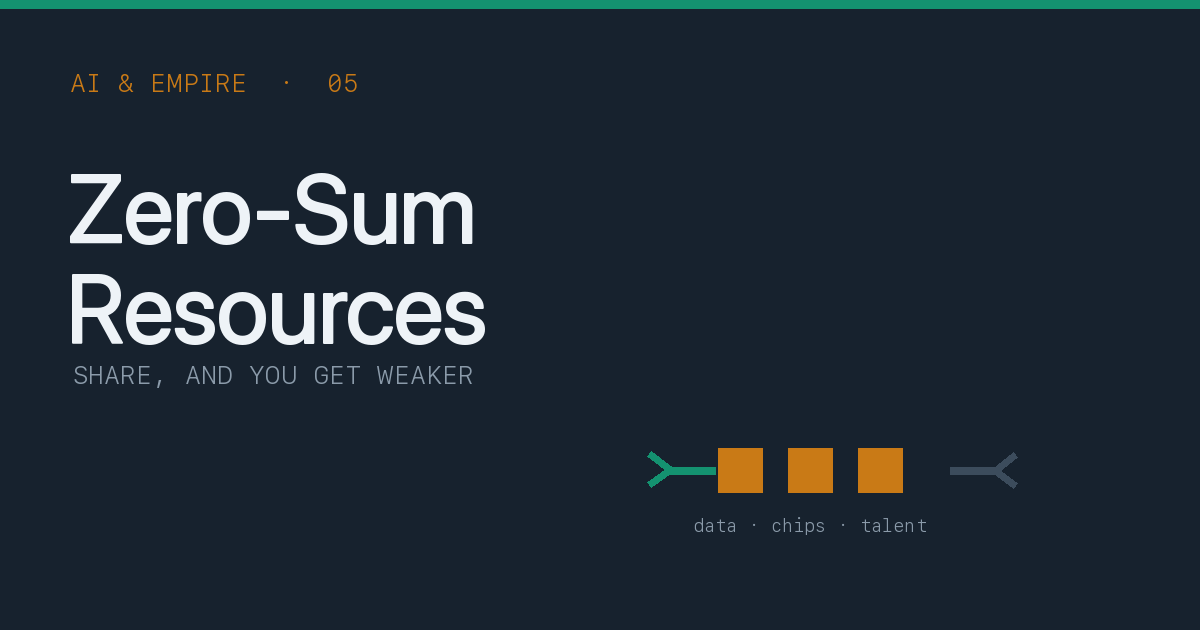
But the core resources of the AI race don’t follow that grammar.
Three resources that run zero-sum
In an early-2026 analysis, the Atlantic Council argues that three resources in the AI race move as a zero-sum structure.
Data. Exclusive possession of high-quality training data ties directly to model performance. And access-restricted data can’t be reproduced by a rival. What I hold is closed to you.
Chips. A tiny number of foundries — TSMC, Samsung — monopolize advanced AI-chip production. U.S. export controls on China have turned that scarcity into a strategic weapon.
Talent. Frontier AI researchers are scarce, on the order of tens of thousands. Big Tech’s hiring wars redistribute the talent pool itself — when one side recruits, another’s pool directly shrinks.
The three share one trait. It isn’t a structure where sharing benefits everyone; it’s one where securing a resource makes your rival weaker.
The internet grew the more it was shared. AI’s core resources make me weaker the more I share.
Why this reshapes geopolitics
When resources are zero-sum, the character of the competition around them changes too.
In a world of network effects, a rival’s growth helps you — the pie grows together. But in a zero-sum world, a rival’s gain reads as your loss. Here the incentive to cooperate weakens, and the incentive to secure and control grows stronger.
Layer on AI’s dual-use nature from an earlier piece — a civilian tool that becomes a weapon in months — and the two properties combine: a technology that can become a weapon at any time, standing on resources that make you weaker the more you share. That combination places AI somewhere other than electricity or the internet.
So “who holds the data,” “who makes the chips,” “who takes the talent” is no longer a corporate question. It becomes a national one — a question of technological sovereignty.
Sources. Atlantic Council (2026, Jan 15), Eight Ways AI Will Shape Geopolitics in 2026 — analysis of the zero-sum structure of the AI race’s three resources (data, chips, talent): exclusive data possession tied to model quality and non-reproducible by rivals; monopoly of sub-3nm advanced-chip production by a few foundries (TSMC, Samsung) plus U.S. export controls on China; frontier AI talent on the order of tens of thousands with zero-sum recruiting dynamics.
근거. Atlantic Council (2026, 1월 15일), Eight Ways AI Will Shape Geopolitics in 2026 — AI 경쟁의 세 자원(데이터·반도체·인재)의 제로섬 구조 분석. 데이터의 독점적 보유가 모델 품질에 직결·접근 제한 데이터는 재생산 불가, TSMC·삼성 등 극소수 파운드리의 3nm 이하 첨단 칩 생산 독점과 미국의 대중국 수출 통제, 프런티어 AI 인재 수만 명 수준의 제로섬 영입 동학.
The last piece ended on a promise: keeping people isn’t only about salary — it’s about structure. This piece is about what that structure actually is.
Why salary isn’t enough
An organization’s first instinct to keep talent is usually money. Raise the salary, add the perks. But the data points somewhere else.
In a 2025 survey, 76% of employees said they’d be more likely to stay with an employer that offers continuous learning opportunities. More than half said they need additional training to do their current job well. LinkedIn’s 2025 Workplace Learning Report reaches the same conclusion — learning opportunity has risen to the top factor in the decision to stay.
Where people stay isn’t simply where the pay is highest. It’s where they feel they’re growing.
Why this lands harder in the AI era
That growth drives retention isn’t new. What’s new is that AI has shifted the weight of the equation.
Skill compression — the effect from an earlier piece, where AI lifts the floor of the least-skilled more than the ceiling — comes with a condition. It appears only when every member has access to the same tool.
An organization that hands AI to a few top performers merely preserves the existing gap. One where everyone uses it, and keeps learning from it, lifts the entire baseline. Here, “growth opportunity” stops being a perk and becomes an engine of competitiveness.
Growth is why talent stays, and how an organization gets stronger. In the AI era, those became the same thing.
So what is the “structure”?
What, concretely, is the structure that keeps people? Three things.
Equal access. Not just top performers but everyone uses the same tools. Skill compression only works then.
Learning as a constant. Don’t stop at handing over the tool; build a flow of continuous learning from it. That’s the condition 76% said they’d stay for.
Redesigning how work is done. Even if individual tasks get faster, bottlenecks cap the result. The amplification only lands if you rebuild the process alongside the tool.
None of these appear on a salary sheet. Yet they decide why people stay and why they leave.
Where the two pieces meet
The earlier piece said that shedding talent carelessly is letting your organization’s memory drain away. This one is its mirror image — keeping people isn’t about adding to a salary; it’s about building the structure in which they grow.
The cost of losing and the condition for keeping converge on one question: does the organization see talent as a cost, or as a vessel holding a kind of sovereignty? The more AI advances, the higher the stakes of that choice.
Sources. TechClass Learning & Development Survey (2025) — 76% of employees more likely to stay with an employer offering continuous learning; 55%+ agree they need further training. · LinkedIn 2025 Workplace Learning Report — learning opportunity has risen to the top factor in employee retention decisions.
지난 글은 하나의 약속으로 끝났다. 사람을 붙잡는 것은 연봉만의 문제가 아니라 구조의 문제라고. 이번 글은 그 구조가 무엇인지에 대한 이야기다.
연봉은 왜 충분하지 않은가
인재를 지키려는 조직의 첫 반응은 대개 돈이다. 연봉을 올리고, 복지를 늘린다. 그런데 데이터는 다른 곳을 가리킨다.
2025년 한 조사에서 직원의 76%가 지속적 학습 기회를 제공하는 고용주와 함께할 의향이 높다고 답했다. 절반이 넘는 응답자는 현 직무를 제대로 하기 위해 추가 훈련이 필요하다고 했다. LinkedIn의 2025 워크플레이스 러닝 리포트도 같은 결론에 도달한다 — 학습 기회가 잔류 결정의 최우선 요인으로 부상했다는 것이다.
사람들이 머무는 곳은 단순히 보상이 높은 곳이 아니라, 자신이 성장하고 있다고 느끼는 곳이다.
AI 시대에 이 말이 무거워지는 이유
성장이 인재 유지의 동인이라는 건 새로운 이야기가 아니다. 새로운 건, AI가 이 방정식의 무게를 바꿔놓았다는 점이다.
앞선 글에서 다룬 스킬 압축 — AI가 하위 성과자의 실력 바닥을 더 크게 끌어올리는 현상 — 은 조건이 하나 붙는다. 모든 구성원이 같은 도구에 접근할 때만 발현된다는 것이다.
상위 인재 몇 명에게만 AI를 쥐여주는 조직은 기존 격차를 유지하는 데 그친다. 반면 전 구성원이 AI를 쓰고, 그것으로 계속 배우는 조직은 기준선 전체를 끌어올린다. 여기서 ‘성장 기회’는 복지가 아니라 경쟁력의 엔진이 된다.
성장은 인재가 머무는 이유이자, 조직이 강해지는 방식이다. AI 시대에 이 둘은 같은 것이 되었다.
그래서 ‘구조’란 무엇인가
그렇다면 인재를 붙잡는 구조는 구체적으로 무엇인가. 세 가지로 정리할 수 있다.
접근의 평등. 상위 인재만이 아니라 전 구성원이 같은 도구를 쓴다. 스킬 압축은 그때만 작동한다.
학습의 상시화. 도구를 주는 것에서 끝내지 않고, 그것으로 계속 배우는 흐름을 만든다. 76%가 남겠다고 한 그 조건이다.
일하는 방식의 재설계. 개별 작업이 빨라져도 병목이 남으면 성과는 제한된다. 도구 도입과 함께 프로세스를 다시 짜야 증폭이 실현된다.
이 셋은 연봉표에 적히지 않는다. 그러나 사람이 왜 남고 왜 떠나는지를 결정한다.
두 편의 글이 만나는 자리
앞선 글에서, 인재를 무분별하게 내보내는 것은 조직의 기억을 스스로 흘려보내는 일이라고 했다. 이 글은 그 반대편이다 — 사람을 붙잡는 것은 연봉을 얹는 일이 아니라, 그들이 성장할 구조를 만드는 일이다.
내보내는 비용과 붙잡는 조건. 이 둘은 결국 하나의 질문으로 모인다. 조직은 인재를 비용으로 볼 것인가, 기술 주권을 담은 그릇으로 볼 것인가. AI가 발전할수록, 이 선택의 대가는 커진다.
근거. TechClass Learning & Development Survey (2025) — 직원 76%가 지속적 학습 기회를 제공하는 고용주와 함께할 의향이 높다고 응답, 55% 이상이 추가 훈련 필요성에 동의. · LinkedIn 2025 Workplace Learning Report — 학습 기회가 직원 잔류 결정의 최우선 요인으로 부상.
When someone leaves an organization, what exactly does the organization lose? A contract lists their salary and their role — but the things that actually leave with them aren’t written there.
What leaves isn’t on the résumé
The things that never made it onto a résumé leave too. A feel for how the place actually works. An ear for what a customer needs but hasn’t said. Instinct filtered from past failure.
Organizational theory calls this tacit knowledge — the kind you have but can’t quite put into words. It doesn’t live in documents; it settles inside a person as the sediment of experience. Explicit knowledge — manuals, wikis, code comments — stays with the organization when someone goes. Tacit knowledge walks out with them.
None of this is new; it’s Nonaka’s organizational theory from 1994. What’s new is that AI has added a variable to the equation.
The equation AI changed
AI tools accumulate how a person works in a structured form. Years of domain knowledge get left behind as prompts and chat logs. If someone has told an AI, again and again, “handle this task in this order, watching for these exceptions,” part of that judgment — the part never written in any doc — is already made explicit.
And knowledge made explicit can travel with the person.
An engineer leaving for a competitor is one thing. Leaving with their own knowledge, distilled by AI, is another.
Let’s not overstate it. Adapting to a new organization’s culture and processes still takes time; knowledge isn’t copied wholesale overnight. But the direction is clear — as AI advances, the strategic cost of losing talent doesn’t fall. It rises.
So what do you prepare?
Treating talent as a cost and shedding it carelessly isn’t a simple HR mistake in the AI era. It’s letting your organization’s memory drain away — now in a form that can move to a competitor. Keeping people, in turn, isn’t only about salary; it’s a question of structure — which the next piece takes up.
The starting point is surprisingly plain. Before you try to hold on to the person who’s leaving, first build the structure that lets the tacit knowledge of the people already here stay inside the organization. That’s why, in the AI era, talent is less a “cost” than a vessel holding a kind of sovereignty.
Sources. Nonaka, I. (1994), A Dynamic Theory of Organizational Knowledge Creation, Organization Science 5(1) — the explicit/tacit distinction; knowledge you “know more than you can tell.” · Brass & Burkhardt (1993), Potential Power and Power Use, AMJ 36(3) — knowledge embedded in social networks, lost when members leave. AI may partly lower that barrier.
한 사람이 조직을 떠날 때, 조직은 정확히 무엇을 잃는가. 계약서에는 급여와 직무가 적혀 있지만, 실제로 함께 사라지는 것들은 거기에 없다.
사라지는 건 이력서에 없다
이력서에 적히지 않은 것들이 함께 사라진다. 조직이 실제로 어떻게 돌아가는지에 대한 감각. 고객이 말하지 않은 요구를 읽어내는 눈. 과거의 실패에서 걸러낸 직관.
조직론에서는 이걸 암묵지(tacit knowledge)라고 부른다. ‘알고 있지만 말로 옮기기 어려운’ 지식이다. 문서에 담기지 않고, 경험의 퇴적물로 한 사람 안에 쌓인다. 명시지 — 매뉴얼, 위키, 코드 주석 — 는 사람이 떠나도 조직에 남지만, 암묵지는 그 사람과 함께 나간다.
이건 새로운 이야기가 아니다. 노나카 이쿠지로가 1994년에 정리한 오래된 조직론이다. 새로운 건, AI가 이 방정식에 변수를 하나 더했다는 점이다.
AI가 바꾼 방정식
AI 도구는 개인이 일하는 방식을 구조화된 형태로 축적한다. 수년간 쌓인 도메인 지식이 프롬프트와 대화 기록으로 남는다. 누군가 “이 작업은 이런 순서로, 이런 예외를 조심하며 처리하라”고 AI에게 반복해서 지시해 왔다면, 문서에 없던 그 판단의 일부는 이미 명시화되어 있는 셈이다.
그리고 명시화된 지식은 사람과 함께 이동할 수 있다.
해고된 엔지니어가 경쟁사로 가는 것과, AI로 정제된 자신의 지식을 들고 경쟁사로 가는 것은 다르다.
과장은 금물이다. 새 조직의 문화와 프로세스에 적응하는 데는 여전히 시간이 걸린다. 지식이 곧바로 복제되는 건 아니다. 하지만 방향은 분명하다 — AI가 발전할수록, 인재 이탈에 따르는 전략적 비용은 낮아지지 않고 높아진다.
그래서 무엇을 준비할까
인재를 비용으로 보고 무분별하게 내보내는 결정은, AI 시대에 단순한 인사 실수가 아니다. 그건 조직의 기억을, 그것도 이제는 경쟁사로 이동 가능한 형태로, 스스로 흘려보내는 일이다. 반대로 사람을 붙잡는 것은 연봉만의 문제가 아니라 구조의 문제다 — 이건 다음 글에서 다룬다.
준비의 출발점은 의외로 단순하다. 떠날 사람을 붙잡기 전에, 지금 있는 사람들의 암묵지가 조직 안에 남을 구조를 먼저 만드는 것. 그게 AI 시대에 인재가 ‘비용’이 아니라 ‘기술 주권을 담은 그릇’이 되는 이유다.
근거. Nonaka, I. (1994), A Dynamic Theory of Organizational Knowledge Creation, Organization Science 5(1) — 명시지와 암묵지의 구분, ‘알지만 말할 수 없는’ 지식의 개념. · Brass & Burkhardt (1993), Potential Power and Power Use, AMJ 36(3) — 지식이 사회적 관계망에 내재되어 구성원 이탈 시 함께 소실됨. AI가 이 장벽을 부분적으로 낮출 가능성.